 Support l'X
 - Home
- Education
- Academic and Research Departments
- PHYSICS DEPARTMENT
- Laboratory Research Projects
Laboratory Research Projects
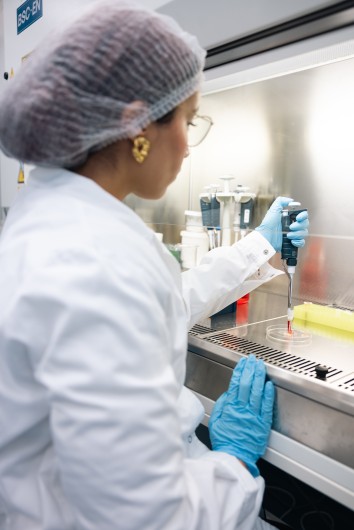
This course is the “research-based training” version of the third-year project, emphasizing immersion in a laboratory and participation in genuine research work for half a day per week. Access to high-tech equipment and exposure to open-ended problems such as those encountered in research laboratories provide extremely valuable training, regardless of the student’s future career plans.
With the supervising researcher, each student will be able to independently acquire the knowledge necessary for the successful completion of the project. The proposed topics correspond to focused work directly related to the internationally recognized research activities of the host laboratories. Projects may be experimental, theoretical, or computational, and may address fundamental or applied aspects. Once the framework is clearly defined—particularly the choice of the weekly time slot based on the availability of both the supervisor and the student—the organization of the work can be managed freely.
Additional information regarding the course structure and the proposed projects can be obtained from guilhem.gallot@polytechnique.edu or taille@in2p3.fr
Schedule
• April–May: Students express their interest to the course coordinators and directly contact the supervisors of the projects they are interested in. This allows them to gather the necessary information to choose among the proposed topics, while supervisors can assess the motivation of the students they meet.
• May : Students send a ranked list of preferred projects to guilhem.gallot@polytechnique.edu. At the same time, supervisors submit a ranked list of students they wish to host.
• Mid-June: Allocation of projects based on the preferences of both students and supervisors.
• Early September to mid-March: Research project carried out in the laboratory, half a day per week, except during holidays.
• Early December: Mid-term presentation.
• Mid-March: Submission of the report and final presentation.
Assessment Methods
The project involves writing a concise report of at least 15 pages (20 pages for a pair), presenting the results obtained and highlighting the scientific maturity acquired by the student, as well as a 20-minute oral presentation (30 minutes for a pair), followed by 10 minutes of questions (15 minutes for a pair).
An intermediate oral presentation of 10 minutes (15 minutes for a pair), organized at the end of the first period (early December), will provide an opportunity to review progress and ensure the project is proceeding smoothly, but will not be included in the final assessment.
Guidelines for Preparing the Report and Oral Presentation
The report should begin with a presentation of the scientific context of your work and define the associated theoretical and/or experimental framework. All results and their interpretation must be presented clearly. In particular, figure axes must be labeled with their physical units, and the text should refer to all figures presented. Do not hesitate to describe the difficulties encountered and the methods used to overcome them. Finally, a bibliography must be included at the end of the report listing the references used during the project.
For the oral presentation, it is important to introduce the topic in a clear and pedagogical manner. Your presentation should be understandable to a physicist who is not a specialist in the field. It is also important to strike the right balance between an overly dense and rushed presentation (trying to include all results) and one that is too superficial and does not reflect the quality and difficulty of your work. Since the presentation lasts only 20 minutes (30 minutes for a pair), it is usually necessary to select the most significant results and those with the richest physical interpretation. As with the report, ensure that all figure axes are clearly labeled with their physical units.
List of Proposed Topics
The Laboratory Research Project may take place in one of the School’s nine physics laboratories. It may also be carried out in one of the laboratories of Université Paris-Saclay, in collaboration with a faculty member from the physics department conducting research there. The list of projects proposed by the laboratories will be updated progressively below. Topics that have already been assigned are indicated in parentheses.