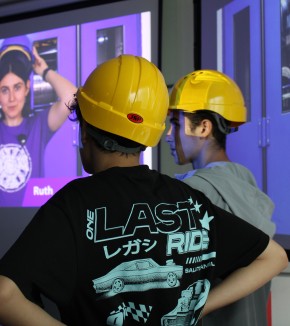
For the European Researchers’ Night on Friday, September 25, high school students from the “Cordées de la réussite” program in Saint-Denis and Argenteuil were invited to tour the laboratories at École Polytechnique. The program included an escape game dedicated to the Higgs boson at the Leprince-Ringuet Laboratory, a sneak peek at the XSeaO2 floating platform, and discussions with researchers from the Molecular Chemistry Laboratory, providing a unique immersion in cutting-edge research.
From 27 to 31 October, the Equal Opportunities Unit organised a 'CPGE Boost' course for 30 scholarship students in their first year of scientific preparatory classes, hailing from all corners of France. This edition took place on the École Polytechnique campus for the first time, enabling these young people to envisage themselves in excellence-driven scientific training programmes and to benefit from the ecosystem of a leading engineering school.
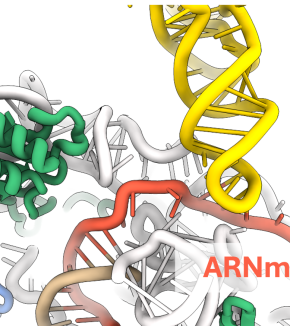
A study by a team from the Structural Biology of the Cell Laboratory (BIOC*), with the participation of the Molecular Chemistry Laboratory (LCM*), published in Nature communications, reveals the mechanisms that initiate translation of the genetic code into proteins in an archaea. This result supports the hypothesis that eukaryotes emerged from the archaeal domain during evolution.
École Polytechnique is strengthening its ties with two first-class academic and scientific institutions in India. During her visit to India in early October 2024, École Polytechnique’s President, Laura Chaubard, signed two student exchange agreements - the first with the Indian Institute of Technology Bombay (IIT Bombay) and the second with the Indian Institute of Technology Delhi (IIT Delhi).
Since October 2022, École Polytechnique has been working with École Penninghen to develop a demonstrator for the XSeaO2 program, financed by the Ifker fund, and aimed at recovering CO2 dissolved in seawater to produce synthetic fuel. The Nautilus project, designed by students at École Penninghen, was chosen as the basis for the sensor design.
Catalysis plays a very important role in chemistry as it promotes and accelerates reactions. In particular, organometallic catalysis, which uses metal...
Credit : Gregory Nocton A new kind of organometallic lanthanide molecule has demonstrated remarkable magnetic properties: the more it is isolated, the...
 Support l'X