 Support l'X
 - Home
- Innovation
- Industry 4.0 and Innovation At École Polytechnique
Industry 4.0 and Innovation at École Polytechnique
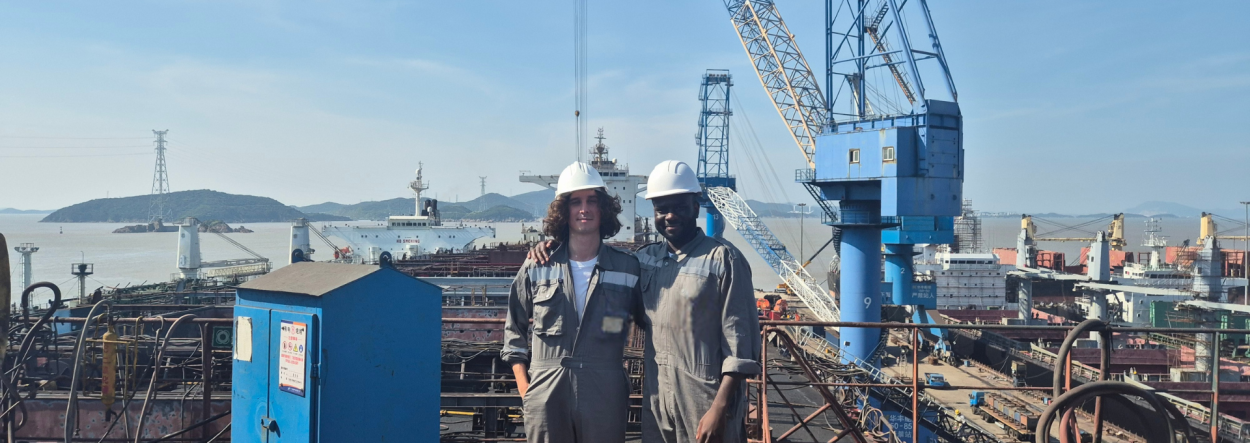 Start-up BlueNose Technologies | X-UP Promo #15 | Innovative wind deflector to reduce fuel consumption of commercial ships
What is Industry 4.0?
Key definitions
Industry 4.0 refers to the set of technological innovations that transform traditional industrial processes into intelligent, connected systems. It is based on the convergence of Information Technology (IT) and Operational Technology (OT), enabling seamless communication between machines, systems, and humans.
The main objective is to optimize production, improve flexibility, and personalize goods and services through real-time data analysis, automation, and artificial intelligence.
Industry 4.0 represents a profound transformation of the industrial sector. It relies on the integration of digital technologies, advanced automation, and system connectivity to create smart, flexible, and highly productive factories. This revolution, also known as the “fourth industrial revolution,” is redefining production, data management, and the skills required in industry.
Key areas of Industry 4.0
Industry 4.0 spans a wide range of sectors:
✔︎ Automotive
✔︎ Agri-food
✔︎ Aerospace
✔︎ Construction
✔︎ Defense
✔︎ Energy
✔︎ Logistics
✔︎ Pharmaceutical
Key technologies of Industry 4.0
✔︎ Internet of things
The IoT transforms factories into “smart factories” by connecting machines, sensors, and equipment to the Internet. The data collected in real time makes it possible to monitor processes, anticipate failures through predictive maintenance, and optimize production. The result: improved quality, reduced costs, and greater responsiveness to changes in demand.
✔︎ Artificial intelligence and machine learning
Artificial intelligence (AI) and machine learning leverage vast amounts of production data to detect anomalies, predict failures, and optimize manufacturing processes. These technologies accelerate decision-making, improve operational efficiency, and drive continuous innovation, enabling companies to remain competitive and responsive to market fluctuations.
✔︎ Robotics and automation
Advanced robotics automates repetitive, dangerous, or complex tasks while collaborating with operators to enhance productivity and safety. This automation makes production more flexible, adaptable to demand, and easily customizable, while freeing up teams for higher value-added tasks and improving overall product quality.
✔︎ Advanced materials
Advanced materials play a central role in Industry 4.0. Thanks to their enhanced properties—such as strength, lightness, and durability—they enable the design of more efficient and innovative products and equipment. Their use is essential in additive manufacturing, smart composites, and embedded sensors, helping to optimize industrial processes while reducing the energy and environmental footprint of production.
✔︎ Smart supply chain
The smart supply chain is one of the key drivers of Industry 4.0. Through the integration of technologies such as IoT, artificial intelligence, and data analytics, it enables real-time traceability, optimization of logistics flows, and anticipation of needs. This digitalization promotes more agile and responsive management while strengthening the resilience and sustainability of supply chains in the face of economic or environmental disruptions.
✔︎ Cloud and edge computing
Cloud and edge computing are technologies that enhance the connectivity, performance, and security of connected industrial infrastructures. Cloud computing provides flexible processing power and storage, facilitating the centralization, analysis, and sharing of information in real time. Edge computing, on the other hand, processes data closer to equipment and sensors, reducing latency and improving system responsiveness.
Benefits of Industry 4.0 for businesses
The adoption of Industry 4.0 offers numerous advantages
✔︎ Increased productivity: automated and optimized processes reduce downtime and boost output.
✔︎ Flexibility: connected factories can quickly adapt to changes in demand and product customization.
✔︎ Improved quality: real-time data analysis enables faster detection and correction of defects.
✔︎ Cost reduction: predictive maintenance and resource optimization help minimize waste.
✔︎ Innovation: the integration of new technologies drives the creation of new products and services.
Industry 4.0 paves the way for smarter, more flexible, and more sustainable production. Companies that invest in these technologies gain competitiveness and enhance their capacity for innovation. Human, organizational, and environmental challenges still need to be addressed, particularly in terms of training and change management.
A 4.0 transition that requires strategy and change management
✔︎ Upfront investment: implementing new technologies can require significant capital outlay.
✔︎ Data security: the growing number of connected devices heightens exposure to cyber threats.
✔︎ Interoperability: integrating disparate systems calls for common standards and seamless compatibility.
✔︎ Change management: effective transformation depends on strong team support and comprehensive training.
✔︎ Digital capabilities: Proficiency in IoT, AI, cybersecurity, and data analytics is essential.
Startup support at École Polytechnique





Partnerships and networks
The School collaborates with major institutional players in industry (CIEDS, Starburst, Hi! Paris, AMIAD, Systematic Paris-Region, CNRS, EIT Manufacturing, Alliance Industrie du Futur, French Tech, etc.) as well as private companies (Safran, etc.), fostering the emergence of innovative projects and supporting technology transfer (IP Paris Innovation Lab, technology transfer initiatives, etc.).





Key terms in Industry 4.0
Take the next step
Join École Polytechnique’s Industry 4.0 ecosystem
✔︎ Discover our support programs and apply to the X-UP incubator to bring your innovation project to life, contribute to transforming industry, and create a tangible impact on the way our society operates.
✔︎ Contact the X-UP incubator team via our contact form.
✔︎ Explore the latest news on the industry of the future, as well as specialized platforms such as Alliance Industrie du Futur.