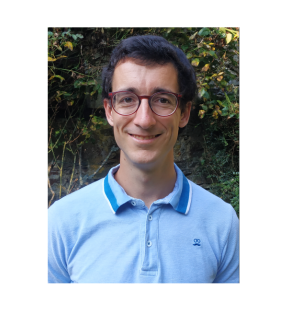
Marc-Olivier Renou holds a junior professorship at the Inria Center of the Institut Polytechnique de Paris, within the PhIQus team, and is affiliated with the Center for Theoretical Physics (CPHT) and the Computer Science Laboratory of École Polytechnique (LIX). Through the QINF project, he is exploring a new frontier in quantum information: fermionic bits. This project is funded by a Starting Grant from the European Research Council (ERC).
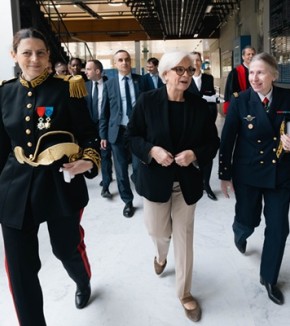
Catherine Vautrin, French Minister for the Armed Forces and Veterans, visited École Polytechnique on April 17 for the Defense Quantum Forum, organized at École Polytechnique by the Defense Innovation Agency. She reviewed the X24 and X25 classes and reminded them of the historic significance of the ties between their School, the Nation, and the Armed forces.
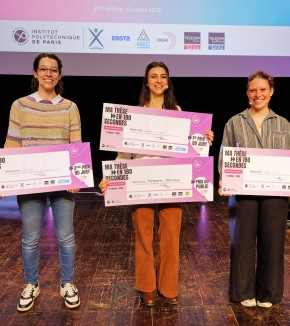
Margherita Castellano (CMAP*), Magali Korolev (CPHT*), and Kate Sorg (LOB*). Three doctoral students from laboratories affiliated with École Polytechnique were honored during the “Ma thèse en 180 secondes” local competition at Institut Polytechnique de Paris.
The two researchers from the Center for Theoretical Physics (CPHT*) were interviewed on France Culture’s “La Science au Labo” series for their work on extending the holographic principle, which could lead to a theory of quantum gravity.
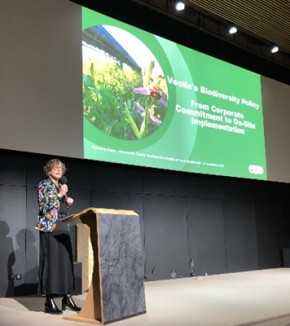
Since its creation in 2009, the Mathematical Modelling and Biodiversity Chair (MMB), supported by École Polytechnique and its Foundation, in collaboration with the National Museum of Natural History and supported by Veolia, has been exploring the major challenges of biodiversity at the interface between applied mathematics and ecology. Through interdisciplinary research programmes, scientific meetings and training initiatives, the Chair brings together nearly 150 experts from international laboratories and research institutions to address fundamental questions about population dynamics, evolution and ecosystem resilience.
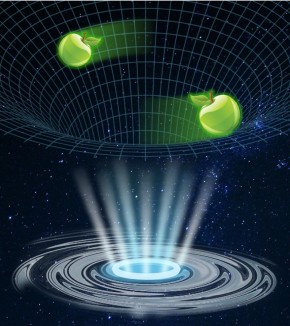
A collaboration involving researchers from the Center for Theoretical Physics (CPHT*) has proposed a theoretical formalism that provides a description of gravity and gravitational waves at the “edge” of the universe. This breakthrough could provide tools for unifying general relativity and quantum mechanics.
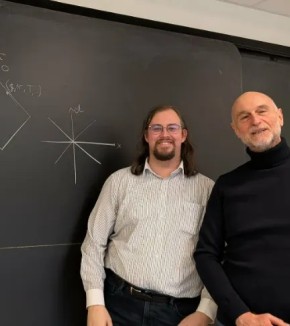
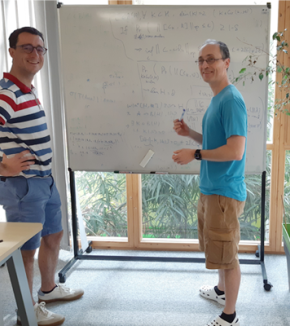
The internationally renowned Slovenian mathematician Igor Klep is joining the Laboratory of Computer Science (LIX) and the Center for Theoretical Physics (CPHT) at École Polytechnique as a Gaspard Monge Visiting Professor. A professor of mathematics at both the University of Ljubljana and the University of Primorska in Slovenia, Igor Klep is collaborating on quantum information theory research with the PhIQus research group, led by Marc-Olivier Renou, INRIA Saclay Junior Professor Chair and affiliated researcher at LIX and CPHT.
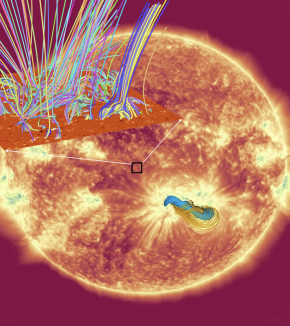
A study published in The Astrophysical Journal Letters by an international team coordinated by Tahar Amari, CNRS research director at the Center for...
The year 2025 has been proclaimed International Year of Quantum Science and Technology by the United Nations. In the 20th century, quantum mechanics radically changed the way we think about the physical world. Today, quantum physics is in the midst of a renaissance that is opening up new and unexpected applications. Laurent Sanchez-Palencia, Director of Research at the Center for Theoretical Physics (CPHT*) and Deputy Director of the Quantum-Saclay center, gives us an overview of this “second quantum revolution”.
In an article published in the journal Science, an international collaboration involving researchers from the Centre for Theoretical Physics (CPHT*) proposes a tool for estimating the difficulty of many problems yet to be solved, as well as the effectiveness of methods developed to tackle them, including quantum algorithms.
Theoretical physicist Carlota Andres and economist Julien Combe are the winners of two ERC Starting Grants supported by Ecole Polytechnique. This funding from the European Research Council helps early-career researchers to build their teams and pursue their most ambitious ideas.
Balt van Rees, a researcher at the Center for Theoretical Physics, is interested in the mathematical framework of quantum field theories, which are used in many areas of physics, still raises many questions. He is leading the QFTinAdS project funded by the European Research Council.
 Support l'X