 Support l'X
 The climate and AI: Understanding tomorrow's extreme weather events
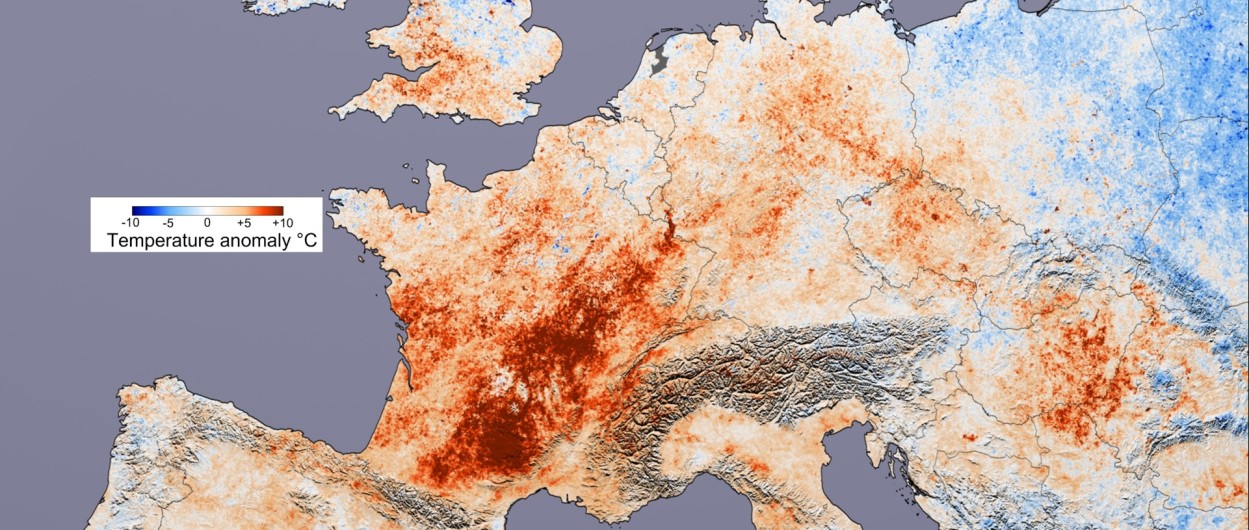 Carte des températures lors de la canicule de l'été 2003 en Europe.
“Originally, I was considering a career in finance,” says Amaury Lancelin. But a lecture at École Polytechnique in 2022 on climate and energy challenges was a turning point. And the education at École Polytechnique provides a good foundation for research as well. ” He therefore reached out to researchers in this field and decided to pursue a thesis at the Dynamic Meteorology Laboratory, one of France’s leading climate science laboratories located at École Polytechnique, École Normale Supérieure (ENS/PSL), and Sorbonne University. The laboratory director, Freddy Bouchet, a research director at the CNRS and professor at ENS/PSL, proposed an ambitious thesis topic: studying the statistics of extreme events, whose frequency is expected to increase with climate change. These events have significant impacts, particularly on electrical infrastructure.
The challenge is daunting. Extreme events are, by definition, rare. Knowing precisely the return period of a heatwave like the one that struck France and Europe in 2003, for example, is still out of reach. “We don’t have enough observational data,” explains the young researcher. “And traditional physical models, while indispensable, are extremely resource-intensive. To obtain reliable statistics, they would have to run for an extremely long time.”
The AI Boost
“We’re witnessing a revolution in climate science with the advent of AI. Emulators, which emerged in 2022–2023, have radically changed traditional approaches. ” A revolution that forced him to reorient his thesis topic, which was initially to develop interpretable models, that is, models whose behavior can be tracked and explained from a physical standpoint, whereas the artificial neural networks on which these new methods are based remain black boxes. But they are incredibly effective.
These AI emulators are trained to mimic the dynamics of large-scale physical models of the atmosphere, meaning they predict the evolution of physical quantities based on those provided at a given moment. But questions remain when it comes to running them not for 15 days, but for thousands of years: do they agree with the physical models they are supposed to emulate?

Stability and Coherence
First, Amaury Lancelin and his colleagues from Freddy Bouchet’s team at the LMD and those from Pedram Hassanzadeh’s team at the University of Chicago, notably Alexander Wikner, used a physically based model of intermediate complexity (PlaSim) to simulate 100,000 years of climate data (without accounting for global warming so as not to complicate the analysis initially) Several dozen of these simulated years were then used to train the AI emulator. Finally, the emulator was also run for the equivalent of 100,000 years.
“The emulator is stable; it reproduces the right variations, such as the seasons, but above all, and this was a major unknown, it can extrapolate well beyond the training data, faithfully simulating extreme events of an intensity it has never seen before.” There are still some biases, but this marks a first step toward building confidence in this method. Researchers are now turning their attention to more complex cases, using the state-of-the-art models employed by the IPCC.
Climate Change and the Power Grid
In a second project for his thesis, Amaury Lancelin combined this AI method with physical models to achieve the best of both worlds: significant computational gains while maintaining confidence in the quality of the simulated data. Algorithms for simulating rare events are already the specialty of his thesis advisor, Freddy Bouchet. They involve using a physical model to simulate a set of climate trajectories, then favoring those that lead to extreme events by assigning them weights. “I used AI specifically to perform this guiding role,” explains the doctoral student. “Thanks to the weights, we can then calculate statistics on the simulated extreme events. In terms of resources, we gain a factor of 100! ”
Ultimately, these tools could aid, for example, in studies on climate change adaptation. Heat waves, among other factors, are extremely important for the design of future power lines. “Excessively high temperatures cause cables to expand and come closer to the ground, posing a particular risk of causing fires. Furthermore, repeated exposure to very high temperatures can lead to accelerated material fatigue,” notes Laurent Dubus, scientific lead at RTE. Anticipating temperature extremes therefore allows for more robust design.
Furthermore, Amaury Lancelin’s work, which is very much focused on methodology rather than practical applications, could prove useful in other fields of the physical sciences.
For more information:
Publication scientifique en preprint : Amaury Lancelin, Alexander Wikner, Laurent Dubus, Clement Le Priol, Dorian S. Abbot, Freddy Bouchet, Pedram Hassanzadeh, and Jonathan Weare. AI-boosted rare event sampling to characterize extreme weather. arXiv:2510.27066
*LMD : une unité mixte de recherche CNRS, ENS-PSL, Sorbonne Université, École polytechnique, Institut Polytechnique de Paris, 91120 Palaiseau, France