 Support l'X
 Compact plasma camera for space missions
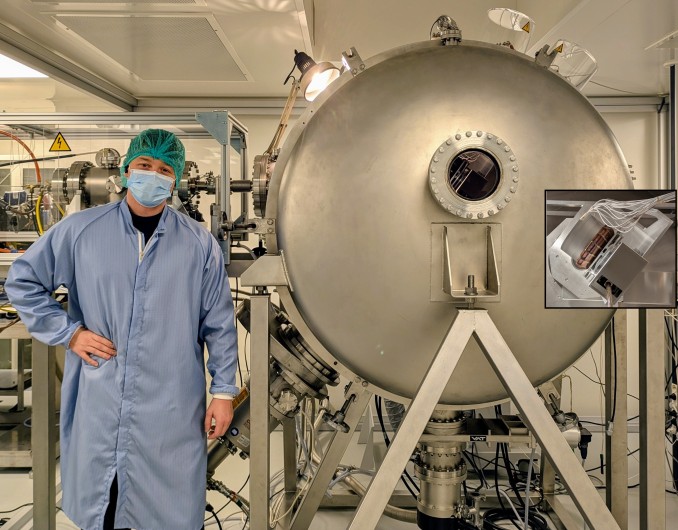 Gwendal Hénaff worked during his thesis on the development of a miniaturised plasma camera (shown in the insert photo). This camera underwent calibration tests in a vacuum chamber.
Interplanetary space is not entirely devoid of particles. Stars such as the Sun continuously emit a wind of charged particles (electrons and ions, the constituents of plasma), which intensifies during solar storms. These particles interact with the surroundings of planets that have a magnetic field, such as Earth, giving rise to spectacular phenomena like auroras, but also to others that affect the safety of satellites in orbit or the aircrew of flights over the polar regions. Although the general mechanisms behind these phenomena are known, they remain difficult to predict, and our growing dependence on space technology makes it increasingly urgent to anticipate “space weather.”
The LPP's “Space Plasmas” team, with the support of CNES (the French space agency), has developed 3DCAM, the first plasma camera capable of measuring electrons and ions in space, which is both faster and more compact than conventional instruments. The aim is to count particles at high speed and measure their energy, velocity, and density (what scientists call the distribution function of ions and electrons).
A near-instantaneous hemispheric measurement
“Conventional instruments have a field of view limited to a plane around the satellite,” explains Gwendal Hénaff, who recently defended his thesis at the LPP. “Since they need to measure in three dimensions, these instruments proceed in stages, using deflectors to widen their field of view.” It is also often necessary to carry several similar instruments, which reduces their acquisition speed and increases the bulkiness of probes where resources (space, weight, power consumption, etc.) are limited.
In his thesis, supervised by Matthieu Berthomier, CNRS research fellow at the LPP and chair of the CNES working group on the Sun, the Heliosphere, and Magnetospheres, Gwendal Hénaff worked on a new optical topology to obtain a field of view covering an entire hemisphere and a measurement in a few tenths of a second instead of a few seconds for conventional instruments. "The idea of this optical topology, forming interlocking donuts, emerged more than ten years ago, but it was complex to implement. Our team realized that it could only be implemented using recent advances in additive manufacturing through 3D printing," continues the young physicist.
Technologies capable of printing high-quality materials with sufficient resolution for space flight have only been around for a few years. After extensive work to optimize this optical topology and numerous printing tests, researchers obtained a prototype that met their requirements. However, two other technological barriers also had to be overcome.
Future space observation and space weather missions
On the one hand, Gwendal Hénaff has developed a selective metallization method that allows electrodes to be deposited on the non-conductive resin part printed in 3D. These electrodes are necessary to functionalize these optics, which must deflect the charged particles toward a detector on which an image of the plasma surrounding the probe is formed. On the other hand, the electronics of the plasma camera's imaging detector were specifically designed at the LPP in the form of an integrated circuit capable of counting electrons and ions in the instrument's 64 viewing directions. These miniaturized electronics greatly reduce the resources required.
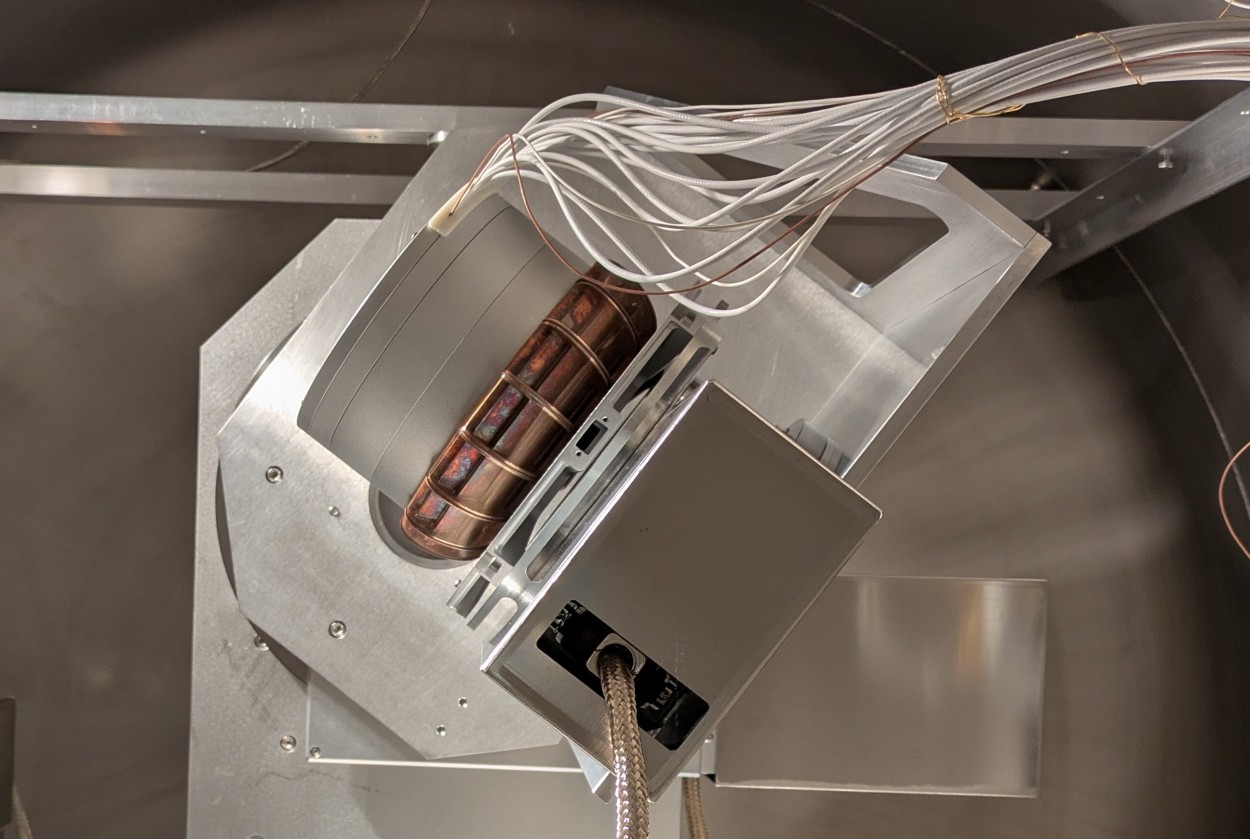
The plasma camera prototype has undergone an initial phase of testing and calibration in the laboratory. Gwendal Hénaff is now working on a qualification model, which would be representative of an instrument that could actually be carried on board a probe. From 2028, a flight model of 3DCAM could fly aboard a low-orbit space probe for validation, before being deployed on constellations dedicated to acquiring data for space weather. The LPP plasma camera has also been selected for the Plasma Observatory mission, which is being studied by the European Space Agency as part of its scientific program.
Article's reference :
*LPP: a joint research unit CNRS, Observatoire de Paris-PSL, Sorbonne Université, Université Paris-Saclay, École Polytechnique, Institut Polytechnique de Paris, 91120 Palaiseau, France