 Support l'X
 Gas giant Saturn influenced by a tiny moon
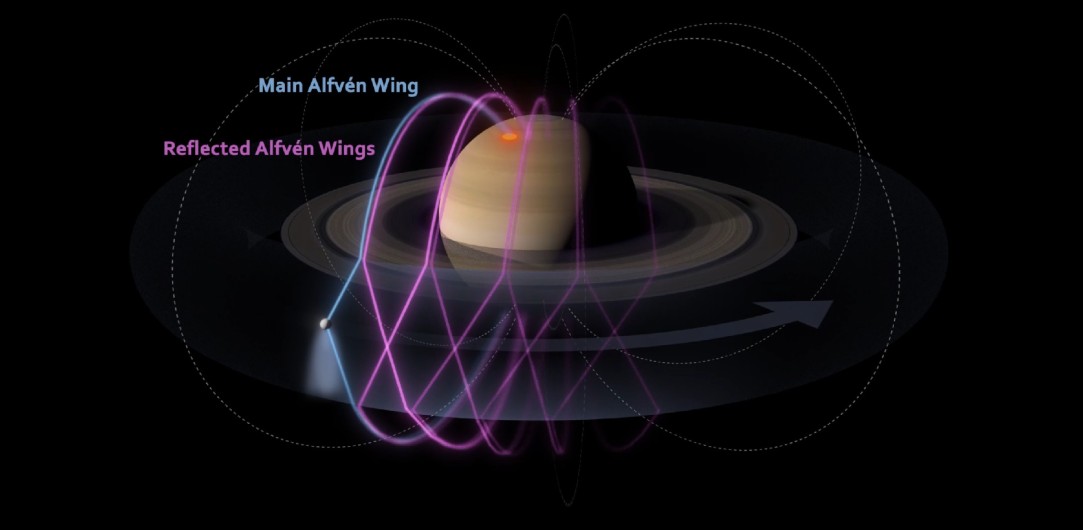 Animation of the electrodynamic interaction between Enceladus and Saturn. The main Alfvén wing is shown in blue, and the reflected Alfvén wings in magenta. Design & animation: Fabrice Etifier - École Polytechnique.
The second-largest planet in the solar system by size, with a volume equivalent to more than 760 times that of Earth, Saturn has numerous moons. Among them, Enceladus orbits more than 200,000 kilometers from the gas giant. Though small in size (500 kilometers in diameter), Enceladus became famous due to the water and dust geysers erupting from its south pole, discovered in 2005 by the Cassini probe.
By analyzing data from this space mission, which concluded in 2017, an international collaboration involving scientists from the LPP* has highlighted the significance of Enceladus’s electromagnetic influence on its host planet. Like many planets, Saturn has a magnetic field that extends around it, forming a magnetosphere (analogous to an atmosphere). Although invisible, this magnetosphere manifests through complex interactions with its surroundings.
13 Years of Data Scrutinized
For example, charged particles such as electrons can be accelerated along magnetic field lines and collide with particles in the planet’s atmosphere, resulting in light emissions known as auroras. “The Cassini mission had observed Enceladus’s auroral footprint at Saturn’s north pole, meaning that magnetic field lines connect Enceladus to the planet, allowing particles to be accelerated from the moon to the poles,” explains Lina Hadid, a CNRS research scientist at the LPP. “However, all observations related to the electrodynamic coupling between Enceladus and Saturn were previously limited to data recorded during Cassini’s flybys of the satellite.”
In their new study, the researchers used measurements from all of Cassini’s passes through the magnetic field lines connecting Enceladus and Saturn over the mission’s 13 years. “We found the signature of waves called ‘Alfvén wings’ by particularly observing the polarization of the magnetic field,” details Thomas Chust, a CNRS research scientist at the LPP.
Enceladus: A Generator of Alfvén Waves
These electromagnetic waves result from the interaction between Saturn’s magnetic field and Enceladus and propagate from the moon to the planet’s poles. However, they also undergo partial reflections, similar to light reflecting off glass, at Saturn’s upper atmosphere (ionosphere) and at the “Enceladus torus,” a cloud of particles ejected by the moon’s geysers and scattered along its orbit.
Assistant IA a répondu :
Animation of the Electrodynamic Interaction Between Enceladus and Saturn. The main Alfvén wing is shown in blue, and the reflected Alfvén wings are shown in magenta. The corotation of the Enceladus torus is indicated by the arrow. The relative sizes of Saturn and Enceladus are not to scale. Design & Animation: Fabrice Etifier – École Polytechnique.
For the first time, the study shows that the magnetic interaction is not confined to the vicinity of Enceladus’s plumes. These Alfvén waves are detected far in its wake, more than 2,000 times the radius of the satellite, or over 500,000 kilometers. This moon thus acts as a giant planetary-scale generator of Alfvén waves. “This opens up new perspectives for studying other celestial bodies, such as Jupiter’s moons or exoplanets,” adds Lina Hadid. There is still much to learn about Enceladus, which is believed to harbor a subsurface ocean. A major mission to this icy moon is currently under consideration at the European Space Agency.
Article Reference:
Hadid, L. Z., Chust, T., Wahlund, J.‐E., Morooka, M. W., Roussos, E., Witasse, O., et al. (2026). Evidence of an extended Alfvén wing system at Enceladus: Cassini's multi‐instrument observations. Journal of Geophysical Research: Space Physics, 131, e2025JA034657. https://doi.org/10.1029/2025JA034657
*LPP: a joint research unit CNRS, Observatoire de Paris-PSL, Sorbonne Université, Université Paris-Saclay, École Polytechnique, Institut Polytechnique de Paris, 91120 Palaiseau, France
The collaboration includes laboratories in France (IRAP, ISAE-SUPAERO, LATMOS, LAM, and LIRA/Observatoire de Paris) and internationally: IRFU (Sweden), MPS (Germany), CAS (Czech Republic), ESA (European Space Agency), DIAS (Ireland), MSSL/UCL and Imperial College (United Kingdom), and, in the United States, APL, UCLA, as well as the universities of Michigan, Boston, and Iowa.