 Support l'X
 Mechanics under extremes
You have been an assistant professor in the Mechanical Department at École Polytechnique for two years. What has been your career path?
I did my undergraduate studies in Production Engineering at the National Institute of Technology in Trichy in south India. I then went to the USA to do my master’s and PhD at the Johns Hopkins University in Baltimore where my focus was on mechanics and materials. This is where I discovered the field of dynamic behavior of materials, which has become my research area. After a post-doc and a few years as a researcher at ETH in Zurich, Switzerland I came here to École Polytechnique.
What motivated you to study mechanics?
My background is essentially in engineering; I liked physics in school. I was very comfortable and excited with hands-on work in college. I was then introduced to more rigorous methods of studying mechanics, especially experimental mechanics, during my graduate studies so this became a natural direction for my career. My teachers and mentors taught me how to ask questions in a scientific way, which is the first step of doing science. Our work was at the intersection of mechanics and material sciences, so interdisciplinarity became an essential part of my research philosophy, which I believe is powerful. And there was a little bit of serendipity involved as well.
Your aim is to explore the behavior of materials under extreme conditions. Could you tell us more about it?
If I take a material and I pull on it slowly, the material will have a particular resistance. Now, if I pull on the same material very rapidly, the resistance of the material to this load I applied is completely different. The objective of my research, in general, is attempting to understand how the material responds to the different speeds and why it does that. This involves understanding the material at the microscopic and macroscopic scales across time scales that last from minutes down to microseconds. Right now, I am studying a specific type of material system which we call shape memory alloys.

We do not have a fundamental understanding of how shape memory alloys respond to very large stresses in very short times; this is the goal of our work
What are shape memory alloys?
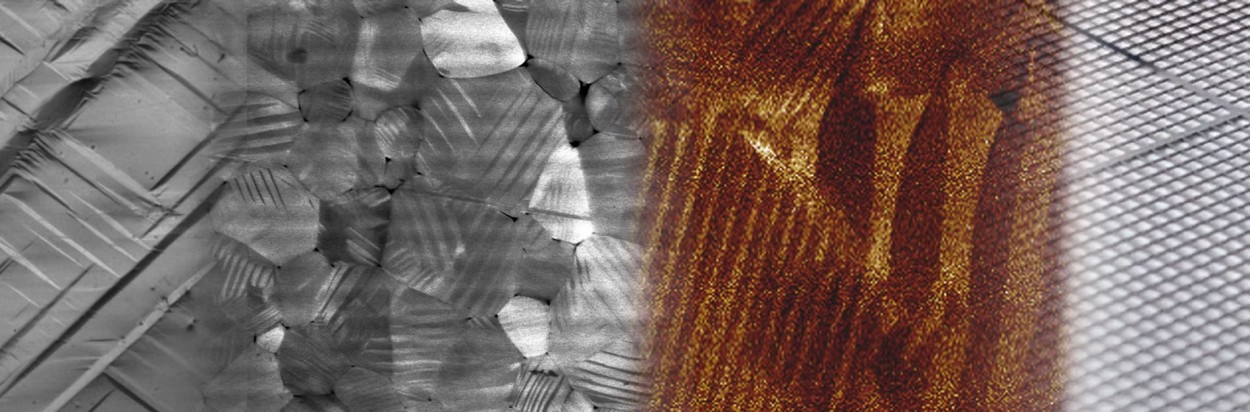
It's a class of materials with specific combinations of metals. Nickel-titanium alloys (NiTi) are examples of such materials. It's called shape memory, because if you pull on it, it changes its shape but if apply a temperature change, it goes back to its original shape. This is unusual for metallic systems. Some shape memory alloys also exhibit this property when a magnetic field is applied. At the microscopic scale, this is due to the chang of the arrangement of atoms in the material when a stress is applied. They could be interesting for some applications because in those cases, the material can also absorb or release energy. For instance, other researchers are exploring their use as solid-state refrigerants for air-conditioning/refrigeration. However, we do not have the fundamental understanding of how this structure evolves at very large stresses in very short times, and that is the goal of our work.
How do you proceed?
With this question in mind, we are developing experimental tools to try and answer it. We are building a lab from scratch here at LMS thanks to funding from the Agence Nationale de la Recherche (ANR) and the European research council (ERC). Using gas guns, we will accelerate projectiles to apply precise stresses at short time scales to materials (Split hopkinson pressure bars or Kolsky bars). And we are developing high-speed microscopy and high-speed interferometry measurement techniques to measure local changes in the material properties at very short timescales. We hope to soon have one of the most unique facilities in Europe that allows us to probe this dynamic response of materials under high stresses, high pressures, and at very high speeds.
*LMS: a joint research unit CNRS, École Polytechnique, Institut Polytechnique de Paris, 91120 Palaiseau, France