 Support l'X
 A new microfluidic separation technique
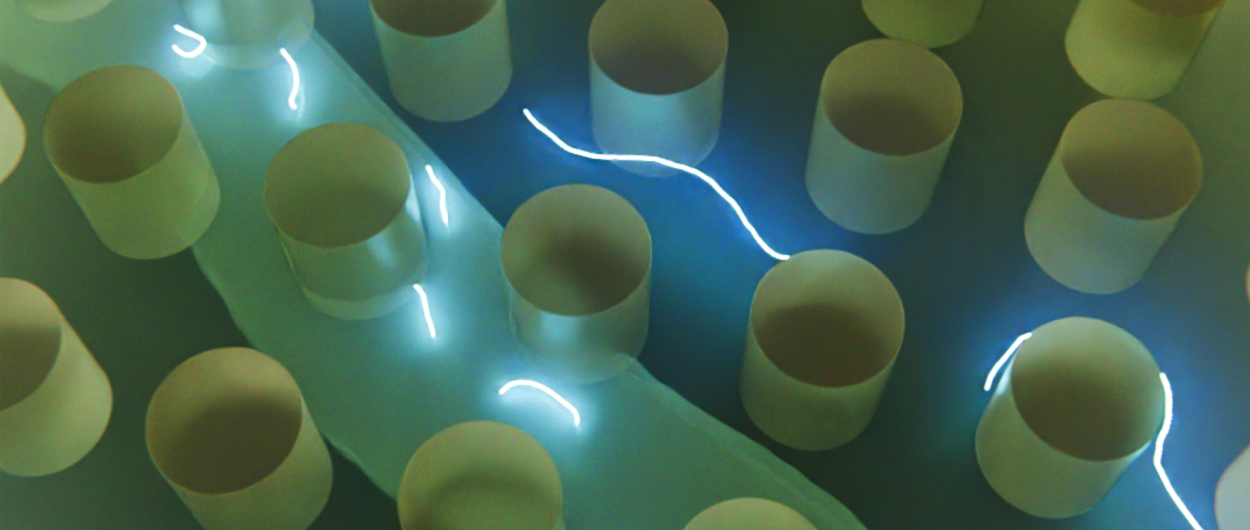 Depending on their length, fibers do not move in the same way in a network of micropillars. Artist's impression. Credit: Julien Husson (https://cellmechanics.jimdofree.com/)
Just as microelectronics enables the control of electron flow and the manufacture of circuits on a microscopic scale, microfluidics aims to understand and manipulate the flow of fluids on a small scale, in micrometric channels. In this highly fertile field of research, a collaboration between the Hydrodynamics Laboratory and the Laboratoire de physique et mécanique des milieux hétérogènes has just discovered an unexpected fundamental phenomenon that opens up new possibilities for applications.
Lateral displacement
Microfluidics applications are already present in chemical, biomedical, and environmental engineering, among others. Examples include separating different chemical species or separating biological molecules (such as DNA) in a fluid. One existing technique for sorting particles involves flowing the fluid through a channel containing micrometric pillars. The smallest particles follow the flow. Above a certain size, collisions with the pillars cause lateral displacement during the passage through the channel, allowing the particles to be filtered out at the end. “However, this technique works for rigid, spherical particles, but not for deformable, elongated objects such as fibers,” explains Blaise Delmotte, CNRS research fellow at LadHyX.
It was somewhat by accident that he and his colleagues found a method that works for these fibers. There were plenty of challenges: “At the experimental level, working with fibers requires a high degree of control. The same is true for reproducing the results through numerical modeling, because you have to take into account the elasticity of the fiber and its feedback on the flow,” the researcher continues.
In the experiments conducted at ESPCI, highly flexible fibers—actin filaments measuring a few micrometers—flow through a network of pillars that are slightly inclined relative to the direction of the current. The shortest fibers zigzag between the pillars, following the flow. The longest fibers behave similarly because they are highly deformable and can fold back on themselves.
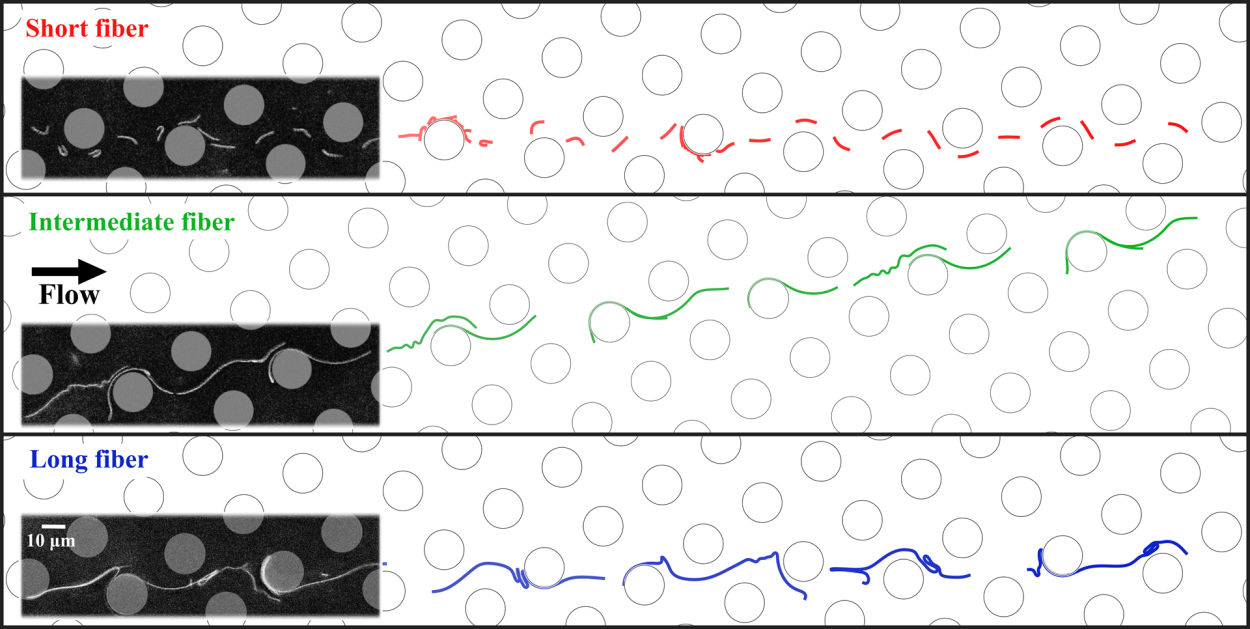
Image caption: Circulation of fibers of different lengths in a microfluidic channel filled with pillars. Experiments (black boxes) and modeling. Credit: Zhibo Li/Clément Bielinski/Anke Lindner/Blaise Delmotte/Olivia du Roure.
Like a bandpass filter
The surprise comes from fibers of intermediate length, which tend to wrap around the pillars and thus “jump” from obstacle to obstacle with a lateral displacement. This result is reproduced from experiment to experiment, with an almost identical angle of displacement. In addition, the numerical models correspond to the experiments. “This system works a bit like a bandpass filter in electronics, i.e., it allows particles within a certain length range to be selected,” explains Blaise Delmotte. This range depends on many parameters, such as the nature of the flow, the size and spacing of the pillars, etc.
In addition, researchers have succeeded in explaining this unexpected phenomenon. The fibers of intermediate length partially wrap around the pillars. The part that remains free is pulled by the flow: internal tension develops in the fiber. However, an object under tension has the property of resisting the flow that pulls it. It will therefore tend to “jump” and move sideways.
This phenomenon could also have applications. Many fields are likely to find it useful to sort fibers, whether they are microplastics, textile fibers, or bacterial colonies that sometimes take the form of long filaments.
Scientists are now continuing their fundamental exploration of fiber behavior in microfluidics thanks to a project funded by the French National Research Agency (ANR).
Article reference:
Z. Li, C. Bielinski, A. Lindner, B. Delmotte, & O. du Roure, A microfluidic band-pass filter for flexible fiber separation, Proc. Natl. Acad. Sci. U.S.A. 123 (6) e2520537123, https://doi.org/10.1073/pnas.2520537123 (2026).
*LadHyX: a joint research unit CNRS, École Polytechnique, Institut Polytechnique de Paris, 91120 Palaiseau, France
*PMMH : a joint research unit CNRS, Université Paris Cité, Sorbonne Université, ESPCI PARIS, PSL