 Support l'X
 Particle physics: The LHCb collaboration plans for the future
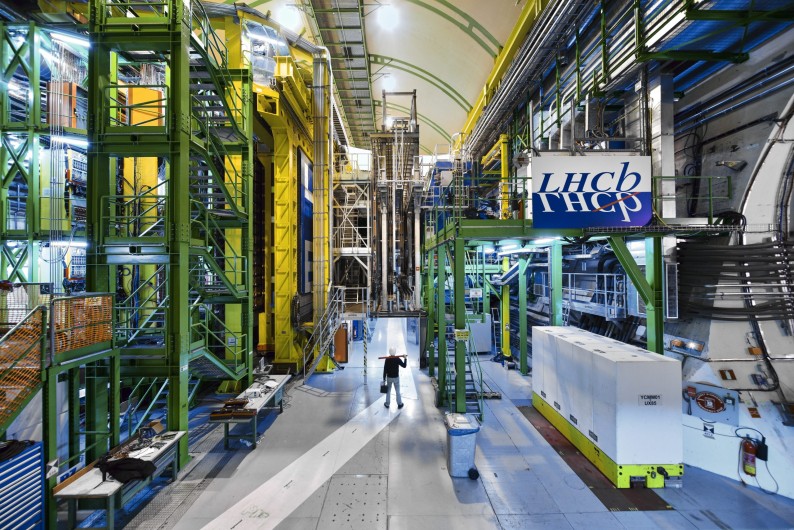 View of the LHCb experiment facility. © 2018-2026 CERN
Near Geneva, 100 meters underground, straddling the French-Swiss border, lies the LHC, the world’s largest particle accelerator. Protons (the building blocks of atomic nuclei) are accelerated there in a ring with a circumference of 27 km. They circulate in both directions and collide at four locations, where massive experiments are conducted: ATLAS, CMS, ALICE, and LHCb.
Matter/antimatter, strong interaction, and quark-gluon plasma
The energy released during collisions gives rise to a multitude of other particles, whose characteristics are tracked by detectors in order to test particle physics theories or identify flaws in them. The “b” in LHCb refers to elementary particles—the b quarks (also known as beauty or bottom quarks)—which the experiment focuses on in particular.
When the LHCb was designed, one of its goals was to study the asymmetry between matter and antimatter—that is, why there is more matter than antimatter in the universe. “But the research program now goes far beyond that,” explains Emilie Maurice, a professor at École Polytechnique and a researcher at the LLR. “In particular, it studies c quarks, another type of quark, to understand how quarks assemble.” LHCb has also just announced the discovery of a new particle composed of two c quarks and one d quark, something of a cousin to the proton.
The LLR has also spearheaded a new research program at LHCb, called SMOG, which allows scientists to study collisions between the LHC beam, consisting of protons or lead ions, and a gas (hydrogen, helium, xenon, etc.) injected into the accelerator’s vacuum tube. “The goal is to understand the strong interaction, one of the four fundamental interactions, and to study the quark-gluon plasma, which is thought to be the state of matter as it existed during the very first microsecond after the Big Bang,” continues Emilie Maurice.
New technologies for new detectors
LHCb, which began operations in 2009, has already undergone an initial upgrade of its detectors. In this cutting-edge research, instrument technology is of paramount importance. In particular, the goal is to be able to record an ever-increasing number of collisions per second (which scientists describe using a factor known as instantaneous luminosity). “The first upgrade aimed to collect data with an instantaneous luminosity five times higher. LHCb is now preparing for the next phase, with up to 40 times more collisions,” says Elisabeth Niel, a researcher at LLR.
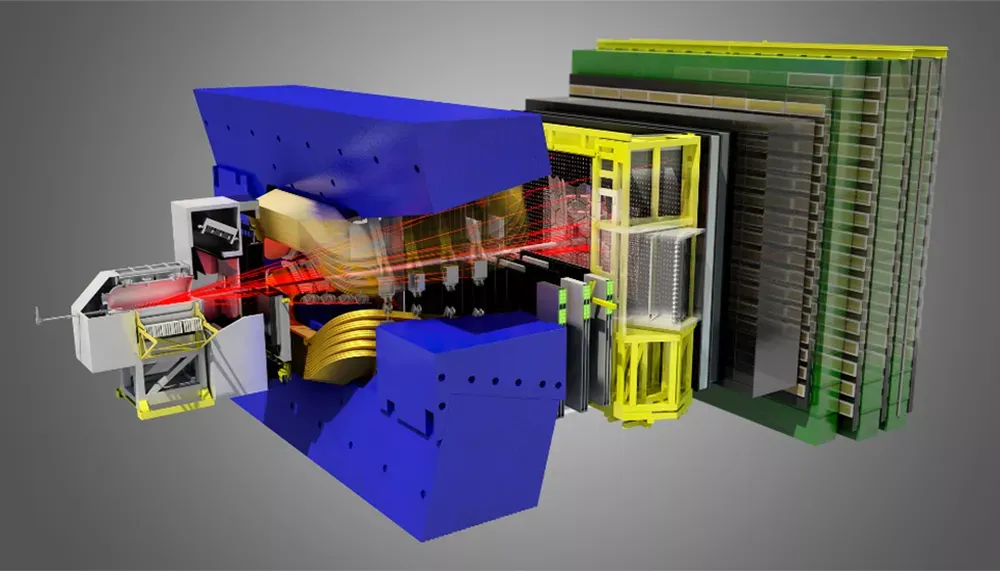
To discuss this second phase of improvements, more than 150 members of the international collaboration (from the UK, Italy, Germany, the United States, China, and other countries) gathered for a workshop held at École Polytechnique.
“The experiment consists of numerous sub-detectors that have specific roles: measuring the particle interaction point, tracking trajectories, measuring energy, and identifying particles,” emphasizes Elisabeth Niel. The scientists therefore discussed the technologies that will be implemented. “At the LLR, we are specifically involved in characterizing technologies for particle tracking. Currently, these are scintillator fibers and silicon strip detectors, and this will evolve toward pixelated silicon detectors (MAPS technology). This will improve spatial resolution and enable the accurate reconstruction of tracks produced during high-luminosity collisions.”
Developments in experiments of this scale are a long-term process. The new LHCb detector is expected to be operational in 2035, but design and construction are beginning now.
*LLR: a joint research unit CNRS, École Polytechnique, Institut Polytechnique de Paris, 91120 Palaiseau, France