 Support l'X
 Breakthrough in Physics: Demonstration of a Photonic time Crystal
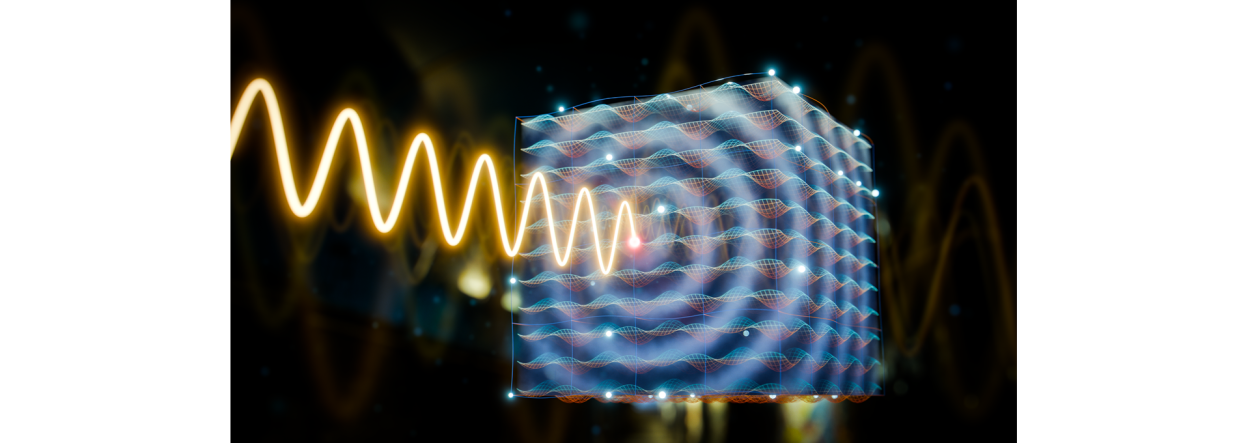 A THz electromagnetic wave induces strong, fast temporal modulations that realize a photonic time crystal: a crystal lattice in time for photons. Credit: B. Schröder/HZDR
Shaping the properties of light as it interacts with materials is the basis for many theoretical discoveries and technological advances, whether in telecommunications (optical fibers), light sources (lasers), or sensors for chemistry and biology. It is a very active field of research.
In physics, the term “crystal” refers to a system whose constituents are arranged in a regular and periodic manner. In solid materials, for example, atoms are arranged at regular, well-defined intervals. This arrangement largely determines the properties of the electrons in the materials—such as the energies they may or may not possess—and thus the properties of the photons (particles of light) they emit (such as their “color,” characterized by wavelength or frequency).
In the 1980s, scientists developed so-called “photonic” crystals, that is, crystals fabricated by regularly alternating several materials whose characteristics affect photons differently (in particular, the refractive index of the materials). This spatial modulation of optical properties now forms the basis of many photonic devices.
Changing optical properties over time
But recently, researchers have asked themselves a new fundamental question: Is it possible to create photonic time crystals? In other words, materials whose optical properties change over time. Until now, research in this area had remained theoretical or was limited to devices based on electrical circuits. In an article just published in Nature, scientists present such a device with optical components, which operates in the terahertz (THz) range, where light oscillates at frequencies of the order of 1,000 billion times per second.
This device consists of micrometer-scale gold crenellated structures, beneath which lies an insulating layer and, finally, a semiconductor material (in this case, a mixture of indium and antimony). These structures act as cavities that trap photons of light between the gold layer and the semiconductor layer.
By directing terahertz laser pulses at this device, the researchers demonstrated that the material’s optical properties—particularly its ability to reflect light—were modulated very strongly over time. This is an experimental feat, as achieving modulation that is both strong and extremely rapid (on the picosecond scale, one billionth of a billionth of a second) was extremely difficult.
Toward a Plasmonic Laser?
The heart of the device is the semiconductor layer: laser pulses create what scientists call surface plasmons, where the electrons form a kind of collective wave. It is as if their mass (their so-called “effective” mass) begins to oscillate, becoming heavier as their speed increases. It is this effect that causes the device’s optical properties to alternate.
Other new phenomena are therefore likely to occur, such as the amplification of photons trapped within the structure. Researchers have already begun to observe signs of this and hope to observe a laser effect soon.
Ultimately, these temporal photonic crystals could be used to create new light sources or new detectors in the terahertz range, whose frequencies lie between those of electronics and visible light.
Reference :
Guo, T., Sueiro, J., Andolina, G.M. et al. Plasmonic metamaterial time crystal. Nature (2026). https://doi.org/10.1038/s41586-026-10825-9
*LSI : une unité mixte de recherche CEA, CNRS, École polytechnique, Institut Polytechnique de Paris, 91120 Palaiseau, France
*LPICM : une unité mixte de recherche CNRS, École polytechnique, Institut Polytechnique de Paris, 91120 Palaiseau, France