 Support l'X
 A case study of industrial decarbonization in India
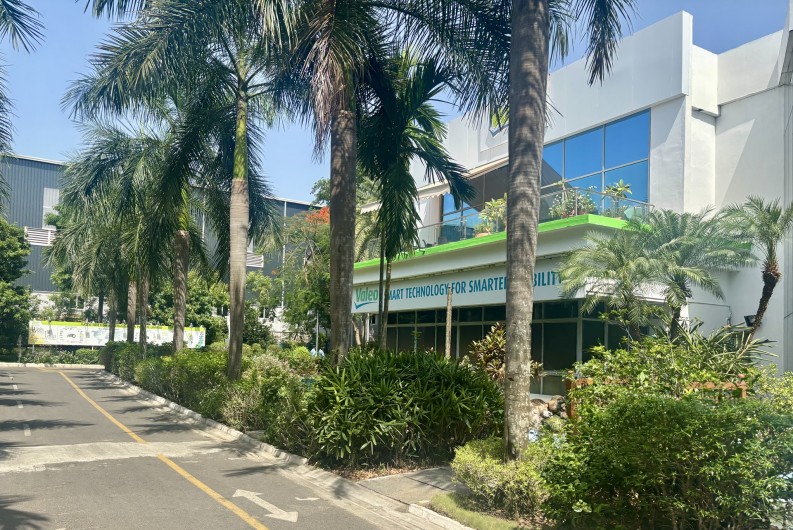 Entrée du site de Valeo Friction Material India ( VFMI) à Chennai (Inde)
You’re working on your thesis in collaboration with a research lab, LINX, and an industrial partner, Valeo. What has your career path been like so far?
My path hasn’t been linear at all! I started with a vocational certificate in sales when I was 16. I worked for several years, notably as a manager in the fast-food industry. But I wanted more. I completed a two-year program to become a car salesperson. Then I earned the equivalent of a bachelor’s and master’s degree in international business. That’s when I started thinking about pursuing a PhD. Following a work-study program, Valeo agreed to let me work on a thesis while working in the company’s purchasing department. I also had the opportunity to meet Éric Godelier, a professor and researcher at LINX, who became my research advisor.
Why did you decide to pursue a PhD?
I wanted to take a reflective and critical step back from management tools, which is difficult when you’re in a purely operational role. A PhD in management science offers that opportunity. My project was developed through an action research approach, meaning a collaborative effort with the stakeholders. There is an issue affecting the company, in this case decarbonization. Often, companies identify a cause and thus label the problem. I believe the researcher’s role is then either to refute or confirm it, but more often to deconstruct the stakeholders’ perceptions of the issue and reveal elements that were not necessarily taken into account.

Your research project focuses on decarbonizing an industrial process used by Valeo to manufacture clutch friction materials in India.
In fact, Éric Godelier, myself, and the company all agreed that the project should build on my thesis advisor’s area of expertise: the automotive industry in India. I was working at a Valeo clutch friction materials site in Limoges. However, the group has a similar operation in Chennai, India. This allowed for a comparative approach, particularly regarding carbon impact.
How did you go about it? What are your initial findings?
I visited nine industrial plants, including Valeo facilities, customer sites, and supplier sites in Chennai, Mumbai, and Coimbatore, to understand what was happening across the entire supply chain. At the Chennai plant, I gathered data on energy consumption, emission factors, and more by interviewing on-site managers and reviewing audits conducted by external firms. I already had this information for the Limoges site. Contrary to expectations, the results show that, for the same level of production, the Indian site emits significantly less CO2 than the French site: nearly 7,000 tons of emissions avoided.
How can we explain the better performance of the Indian plant?
There are multiple factors at play: historical, political, and economic. As early as the late 1990s, the plant was designed to run entirely on electricity. This allows for greater industrial efficiency than gas (which the Limoges plant uses). Furthermore, the goal at the time was to create a flexible and replicable factory model. Initially, electricity was mainly generated from coal, making it very carbon-intensive. But this changed with public policies in the state of Tamil Nadu (India is a highly decentralized country), which promoted the development of solar and wind renewable energy, favored by the climate and geography and supported by economic incentives. More than 80% of the site’s electricity now comes from renewable sources. This outcome defies preconceptions about India, which is often seen as having little interest in decarbonization, and runs counter to macroeconomic considerations, as India remains a country whose energy sector is still heavily reliant on fossil fuels.
LINX, a laboratory of École Polytechnique, Institut Polytechnique de Paris, 91120 Palaiseau, France