 Support l'X
 A Closer Look at Kakeya's Conjecture
A simple question, yet complex to solve
What is the shape with the smallest area within which a needle can be rotated in all directions? This was the question posed in 1917 by the Japanese mathematician Soichi Kakeya. The conjecture that arose from this question bears his name.
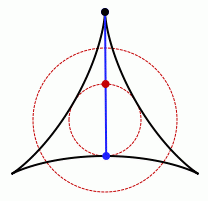
If we visualize the problem in two dimensions, as if on a table, and rotate the needle half a turn around its center, we sweep out the area of a disk with a diameter equal to the length of the needle. This may seem like an obvious answer to Kakeya’s original question. However, with clever rotations and translations, there are possibilities that yield a smaller area, such as the deltoid.
Measuring the Size of Fractal Sets
Moreover, counterintuitively, mathematician Abram Besicovitch demonstrated that the area of a set within which the needle can rotate can be made as small as one wishes. He even proved that a set that simply contains the needle in all directions can have a measure of zero (an area or volume equal to zero)!
To quantify the size of such abstract sets, other measures are more appropriate. “Some sets have fractal dimensions, that is, non-integer numbers such as 1.8 or 2.5. One such measure is, for example, the Hausdorff dimension,” explains Thomas Alazard, vice president of the Department of Mathematics at École Polytechnique.
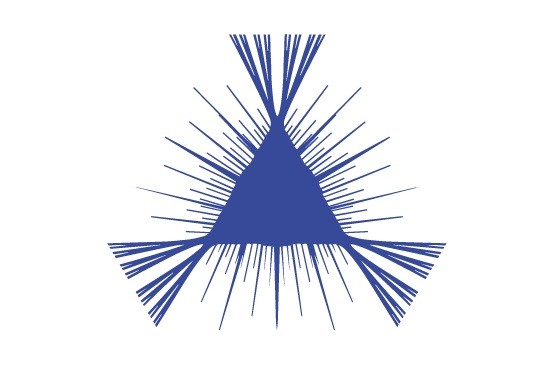
Then, Kakeya's conjecture is stated as follows:
In an n-dimensional space, a set that can contain the needle in all directions must have a Hausdorff dimension equal to n.
In other words, even if this set is so compressed that its usual volume is zero, its fractal dimension must remain maximal.
In early 2025, Hong Wang (Courant Institute of Mathematical Sciences and Institut des hautes études scientifiques) and Joshua Zahl (Nankai University) published a paper on arXiv proving Kakeya’s conjecture in three-dimensional space.
A succession of leading figures in mathematics
In the plane (n=2), the proof had already been established. But for n=3, the problem remained completely open for many years. “It’s a problem that has been well-identified for a long time, with a short statement. Leading figures in mathematics have tackled it, such as Thomas Wolff, Nets Katz, Jean Bourgain, and Terence Tao. That is partly what made the work of Hong Wang and Joshua Zahl so significant,” explains Thomas Alazard.
Quickly recognized and supported by experts in the field, this result generated a great deal of excitement in the mathematical community. The Chinese mathematician was thus awarded the Fields Medal, the one of the field’s most prestigious honor.
A specialist in geometric measure theory, partial differential equations, and harmonic analysis, Hong Wang studied at the École Polytechnique. “The founder of harmonic analysis, which initially involves decomposing a signal into different sine waves (harmonics), is Joseph Fourier. He taught at the École at the end of the 18th century,” notes Thomas Alazard. “The prestigious awards recently bestowed upon Hong Wang underscore the enduring excellence of our educational program. This is very good news for our community.”