 Support l'X
 Collaborative Research Projects by the Class of X2024: Discover the Three Award-Winning Projects
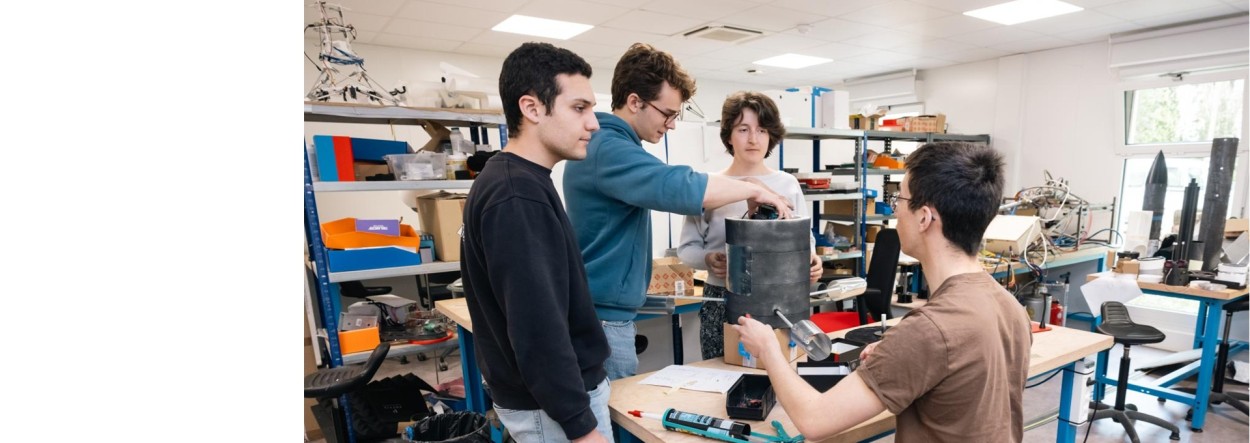
The leaders of twelve collaborative scientific projects—selected by the teaching and research departments from among 113 groups in the X2024 class—presented their projects to a jury composed of prominent figures from academia, the business world, and the media during the finals held on September 14. Three projects received awards.
All second-year Cycle Ingénieur Polutechnicien Program students participate in a PSC. The goal is for them to work collectively (in groups of 4 or 5) to identify, formulate, and work toward solving a major problem, or to design and build an innovative technology demonstrator. Students independently implement, over an extended period of time, appropriate methods and organizational strategies in one or more scientific disciplines.
The PSC involves stakeholders from across the School (scientific departments, laboratories, technical services, DFHM, and the Office of Academic Affairs), as well as its close partners, notably the École Polytechnique Foundation. The topics chosen by students may be related to a School laboratory, a third-party research organization, a company, or a public entity.
Award-Winning PSC Teams
Preparation for the International Physicists' Tournament (IPT)
This project brought together Hadrien Frappier, Jade Godard, Matthieu Hazebrouck, Tristan Tirdea, Antoine Valentin, and Joris Van der Lee, under the guidance of Samy Ben Hamoudi from the Hydrodynamics Laboratory (Ladhyx*) and Nicolas Lemaire (X2021) from the Louis Leprince-Ringuet Laboratory (LLR**) and Guilhem Gallot (Department of Physics, LOB***).
The International Physicists' Tournament is a competition in which teams of students compete on open-ended physics problems that they have been preparing for several months. After winning the French Physicists' Tournament in February 2026 in Strasbourg, the team represented France at the IPT, held in May 2026 in Oklahoma City (United States), which they won.
To prepare for the competition, the students worked on a wide variety of topics: the study of vortices in a vibrating 2D soap film, the formation of bubbles when emptying a bottle of water, counting the number of floors in a building using muon detection, designing a voltmeter that determines a battery’s charge state based on its coefficient of restitution and angular momentum, and designing a ping-pong ball cannon.
Study of a Blood Storage Solution for Military Operations
This PSC project brought together Blandine Chevrot, Alexander Rouyer, Hélène Dupont, and Joséphine Mitoumba, with Alexis Archambeau as coordinator and Jean-Baptiste Raymond and Thierry Gacoin as advisors.
During field operations, blood intended for transfusion must be stored between 2 and 6 °C, regardless of weather conditions, which can range from -10 °C to 50 °C. To this end, the Armed Forces Health Service uses the Golden Hour Box, a U.S.-made container that costs approximately 4,000 euros. The project aimed to develop a version that is more portable, less expensive, and at least as effective.
The students first reverse-engineered the existing container. Using physicochemical analyses (X-ray spectroscopy, X-ray diffraction, NMR), they determined the composition of its phase-change material and its insulator. They then defined a set of specifications (melting temperature between 2 and 6 °C, high enthalpy of fusion, low toxicity, low cost) and explored several alternative materials: deep eutectic solvents, paraffin blends, and then clathrate hydrates. They selected a tetrahydrofuran clathrate, gelled with agar-agar to limit convection. Using their own temperature sensors, they designed a 3D-printed cylindrical prototype in which the material is confined within sealed multilayer pockets.
AI-Based Understanding of Corneal Mechanics
This project brought together Léa Zhu, Nicolas Médard, Tom Zhang, Arthur Dugny, and Mahamadou Sidibé, with Laura Fioni and Clément Madru serving as coordinators and Anatole Chessel as the mentor.
Keratoconus is a corneal disease whose early stages are difficult to detect using conventional methods. The goal of the PSC was to aid in its early diagnosis using a predictive model trained on geometric and biomechanical parameters.
The students worked exclusively with anonymized video clips from the Quinze-Vingts Hospital in Paris, showing the cornea’s dynamic response to a jet of air. Using numerical modeling, they extracted parameters related to thickness, curvature, and deformation, which were then used to train patient classification models. Preliminary results show that, with the right parameters, it is possible to distinguish between patients. Preliminary results show that, with the right parameters, it is possible to distinguish between patients. An unsupervised approach proved less effective on unknown data. Ultimately, incorporating other sources of information, such as optical aberrations, could lead to more reliable screening tools to complement current clinical approaches.
Titles of other projects in the competition
• Reflections – Optimizing the BSPP’s Operational Coverage
• Study and Sizing of Fluid-Structure Interactions in the Nemo Membrane
• ECG Image-Based Diagnosis
• From Yang-Mills Equations to Seiberg-Witten Invariants
• École Polytechnique and Social Reproduction: A Gender-Based Approach
• Light slowing in rubidium vapor****
• Bosonic quantum neural network
• Knowledge tracing assistant for learning programming
• How can machine learning be used to generate anomalies in game theory?
*Ladhyx: A joint research unit of the CNRS, École Polytechnique, and the Institut Polytechnique de Paris
**LLR: A joint research unit of the CNRS, École Polytechnique, and the Institut Polytechnique de Paris
*** LOB: Laboratory of Optics and Biosciences—École Polytechnique, CNRS, INSERM, and IP Paris
**** The group “Slowing of Light in a Rubidium Vapor” has withdrawn from the jury