 Support l'X
 Doctoral students from École Polytechnique stand out in the MT 180 competition
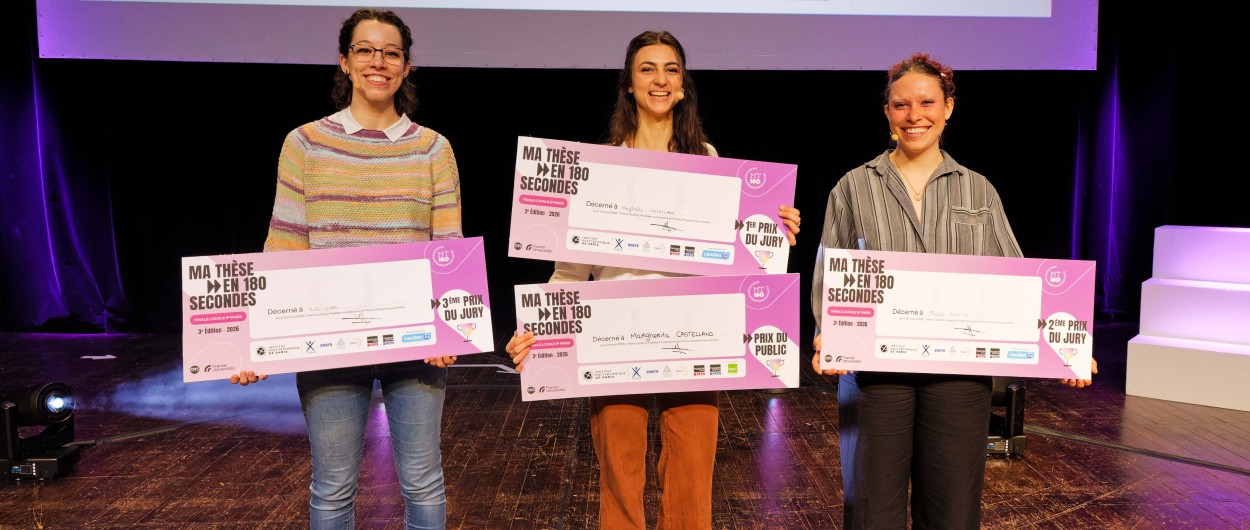 The three 2026 winners. From left to right: Kate Sorg, Margherita Castellano, Magali Korolev ©IP Paris - Alain de Baudus
Summarizing years of research on a highly specialized topic is no easy task. Doing so in an accessible and engaging way is even harder. Add to that the challenge of doing it in exactly three minutes—not a second more—and you have the premise of Ma thèse en 180 secondes (MT 180).
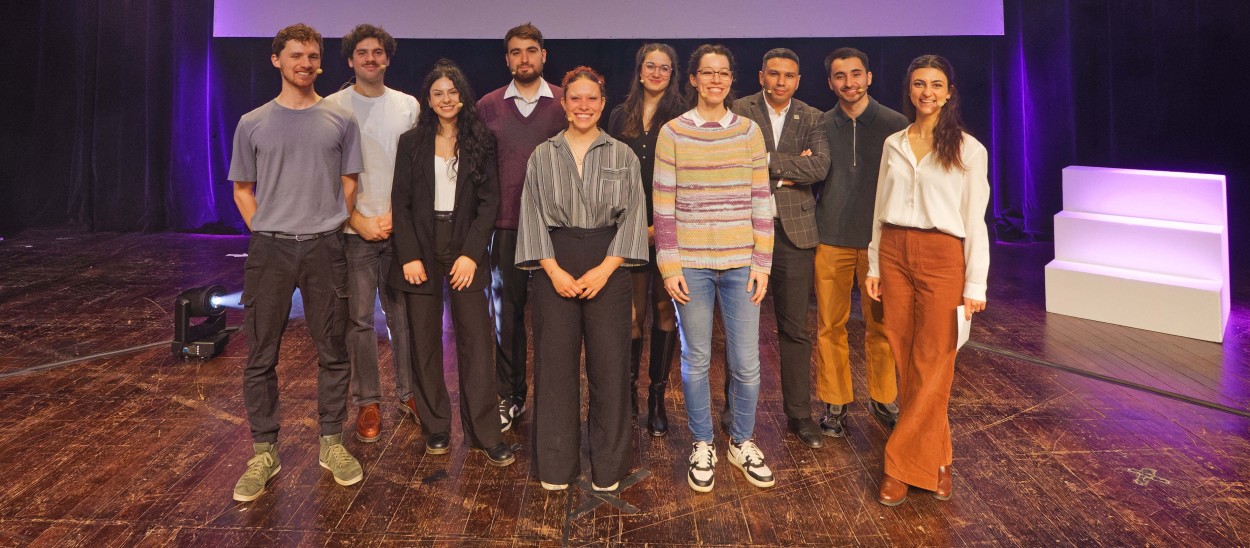
Ten doctoral students prepared specifically for this event and presented their work to a jury as well as an audience that included 200 high school students gathered in the Poincaré Auditorium at École Polytechnique.
Three female doctoral students from laboratories affiliated with École Polytechnique were selected by the jury and the audience. Below is a brief summary of their topics based on their presentations.
Margherita Castellano (CMAP). First Prize from the Jury and Audience Prize.
Believe it or not, the role of soap in bubble formation is still not entirely clear. This is the focus of Margherita Castellano’s thesis. Water and air tend not to mix, and “surfactants” (such as soap) act as mediators. The researcher uses equations rather than experiments to validate approximations that are then used to simulate surfactants in a model. This provides a better understanding of how a few molecules govern the stability of a bubble, a cappuccino, or a cloud.
Magali Korolev (CPHT). Second Prize from the Jury.
Based on the basic rules of chess, there are virtually an infinite number of possible games. In her thesis in theoretical physics, Magali Korolev plays chess—but with electrons. The goal is to understand how electrons will behave based on the rules set for them, and to deduce the electromagnetic properties of materials from this. Depending on whether electrons can move or not, materials can be conductors or insulators. But sometimes, their behavior is much more surprising.
Kate Sorg (LOB). Third Prize from the Jury.
We’re taught that DNA exists in a simple, elegant form, like a twisted ribbon (a double helix). But in reality, DNA isn’t always so orderly. It can fold back on itself to form a structure that resembles... a shelf, which scientists call G-quadruplexes. Using microscopy, Kate Sorg was able to show that these structures are also present in archaea, a group of single-celled organisms. The goal now is to determine what impact these G-quadruplexes have on living organisms.
Thanks to their presentation, Margherita Castellano, Magali Korolev, and Kate Sorg have qualified for the Île-de-France regional final of the MT 180 competition, which will take place on April 16.
*CMAP: a joint research unit CNRS, Inria, École Polytechnique, Institut Polytechnique de Paris, 91120 Palaiseau, France
CPHT: a joint research unit CNRS, École Polytechnique, Institut Polytechnique de Paris, 91120 Palaiseau, France
LOB: a joint research unit CNRS, Inserm, École Polytechnique, Institut Polytechnique de Paris, 91120 Palaiseau, France