 Support l'X
 Fiona O’Brien (MSc&T) at the Transport Research Arena to present a joint research project
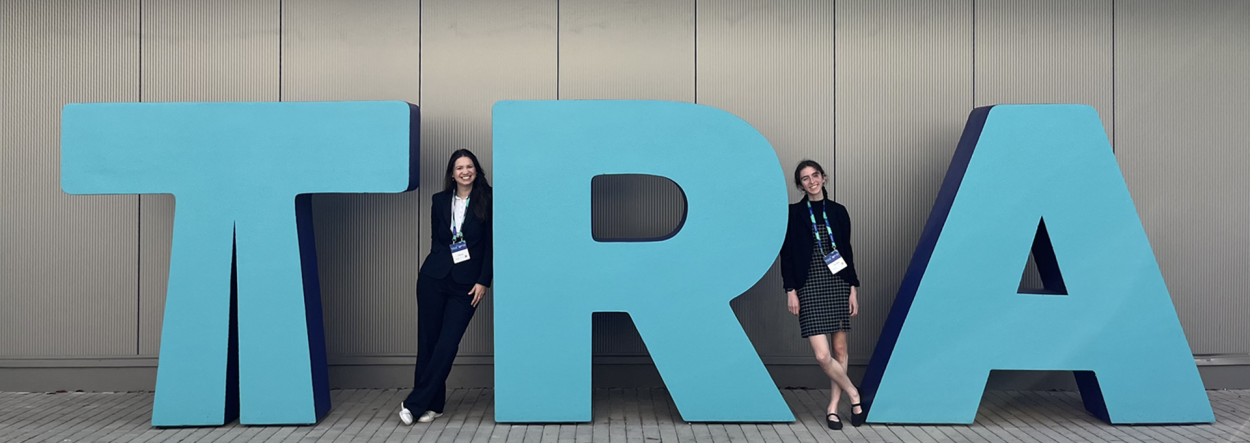
Fiona O’Brien, a student in the Master of Science & Technology (MSc&T) program “Economics for Smart Cities and Climate Policy” at l’X, and Emma Jung, a student at TUM, submitted their research on the "Impacts of the Paris low-emission zone on mobility and environmental outcomes" to the Transport Research Arena (TRA) after having completed this project as part of the course “Cities and Transportation” taught by Professor Zoi Christoforou at École Polytechnique. The authors looked at the "Zone à Trafic Limité" (ZTL*) in Paris, to which they refer as "low emissions zone".
Fostering connections between science students in Europe
To allow qualified students from partner institutions within the European university network EuroTeQ to participate in the course alongside students from École Polytechnique, Professor Zoi Christoforou opened her “Cities and Transportation” course in EuroTeQ’s shared course catalogue. Emma Jung, a master’s student at TUM in Germany, was one of six students from European partner universities who were successfully admitted to the course for the Summer Semester 2025.
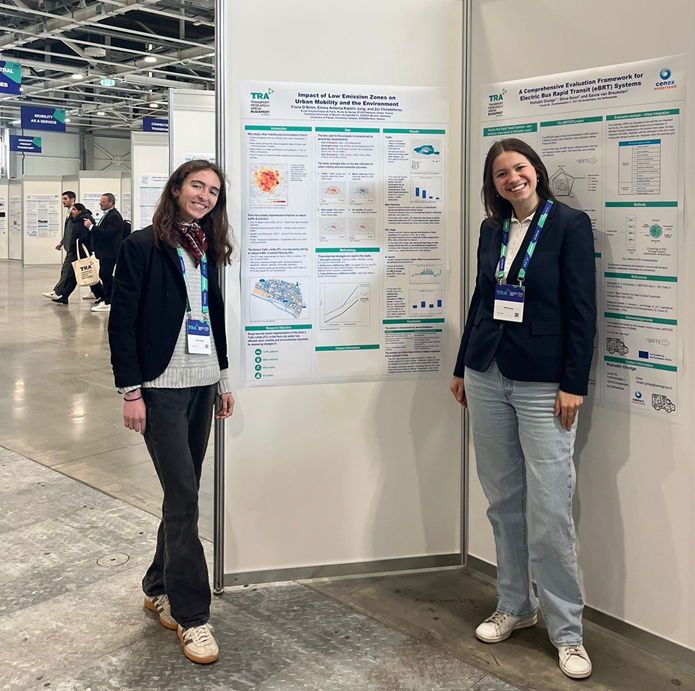
As part of this course, Fiona O’Brien and Emma Jung studied the impacts of the ZTL on mobility and environmental outcomes*, and Professor Zoi Christoforou encouraged them to submit their research project to TRA, where it was selected. The two students presented their research project at the conference in Budapest from May 18-21, 2026, and got the chance to exchange with researchers and professionals from around the world on the topic of low emissions zones.
Fiona O’Brien’s and Emma Jung’s research compares pre- and post-policy trends between districts inside and outside the ZTL to evaluate effects on traffic, metro ridership, bike usage, and air quality. Their findings reveal that the traffic in these zones significantly decreased, but at the same time the air quality worsened citywide.
The outcomes suggest the ZTL may have displaced congestion and emissions to surrounding areas. The findings indicate that complementary policies may be needed to achieve broader sustainability goals.
“Beyond presenting our research, I also had the chance to attend plenary sessions, technical sessions, and strategic sessions related to climate risk in the transport sector, across Europe and beyond, from decarbonization and resilience to international cooperation on sustainable mobility”, explains Fiona O’Brien, who will be graduating in the MSc&T program “Economics for Smart Cities and Climate Policy” this year and is already working as a climate risk and adaptation consultant at Arcadis.
“I thoroughly enjoyed the experience”, Fiona adds, emphasizing that the conference allowed her to learn about several research projects and methodologies directly applicable to her work. Prior to pursuing her at l'X, Fiona worked as a sustainability consultant at EY in New York. She graduated summa cum laude from Yale University in 2022 with a bachelor's degree in environmental engineering.
Taking courses at European partner universities
The shared courses catalogue represents a unique opportunity for students at EuroTeQ’s member universities. While studying in a degree program at École Polytechnique, students can hence take classes at EPFL, the Technical University of Munich (TUM), the Technical University of Denmark (DTU), Eindhoven University of Technology (TU/e), Tallinn University of Technology (TalTech), Technion - Israel Institute of Technology, and Czech Technical University in Prague (CTU).
Each semester, academic directors and professors at the member universities determine which courses will be made available through the EuroTeQ shared course catalogue. Students can then access the catalogue and apply for the courses of their choice. Applications are reviewed to ensure that applicants have the necessary academic background and prerequisite knowledge to successfully participate in and benefit from the course.
During the spring semester 2025, 55 students from École Polytechnique enrolled in courses offered by the European partner universities. Vice versa, 138 students from the EuroTeQ partner universities were admitted to 12 courses at l’X via the shared course catalogue.
Europe’s largest conference on transport research and innovation
The Transport Research Arena (TRA) is Europe’s largest and most prestigious conference on transport research and innovation. Organized every two years by the European Commission and professional partners, the event brings together researchers, industry experts, policymakers, and civil society representatives to explore new solutions for the future of sustainable and smart mobility.
Upcoming publication of the paper
The presentation of their research at the Transport Research Arena in Budapest was only one stop on the international journey: The paper “Impact of Low Emission Zones on Urban Mobility and the Environment” will be published in Springer Nature at the end of the year.
* The city introduced a restricted traffic zone, the Zone à Trafic Limité (ZTL), which limits access to the city center of Paris by prohibiting most non-local through-traffic while allowing residents, deliveries, and public transport.
Fiona O’Brien and Emma Jung’s research compares pre- and post-policy trends between districts inside and outside the ZTL to evaluate effects on traffic, metro ridership, bike usage, and air quality.
The analysis finds that traffic within the ZTL fell by an estimated 33.5 vehicles per hour post implementation, a statistically significant decrease. However, changes in metro ridership and bike usage were smaller and not statistically significant. Air quality worsened citywide following ZTL implementation: PM2.5 increased by 0.529 μg/m³ in ZTL areas relative to control areas, significant at the 99.9% level. This suggests the ZTL may have displaced congestion and emissions to surrounding areas. The findings indicate that complementary policies may be needed to achieve broader sustainability goals.