 Support l'X
 First Involvement of Cycle Ingénieur Polytechnicien students in the UK’s “Model NATO”
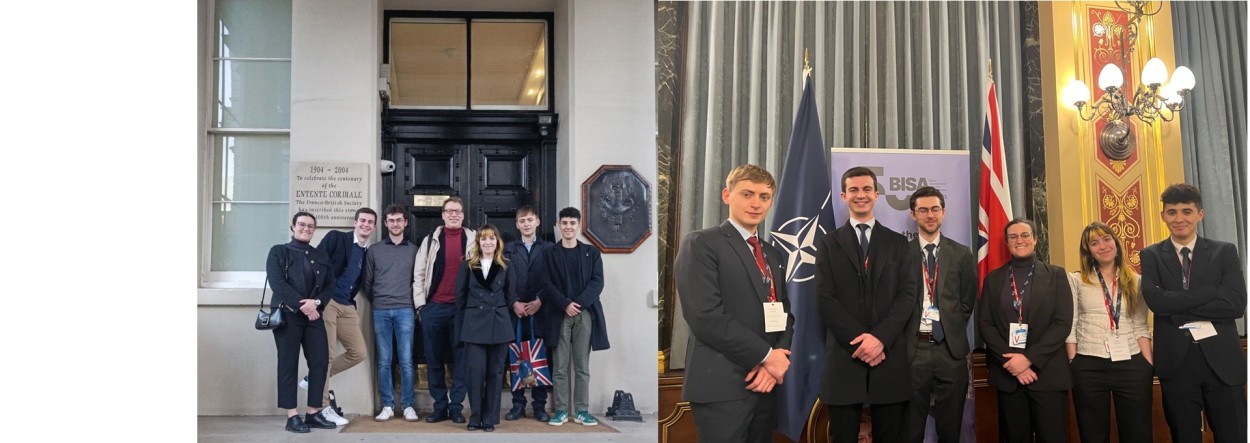
Six second-year students of the Cycle Inénieur Polytechnicien program of École Polytechnique took part on February 25 in the seventh BISA Model NATO, which took place in London at the Foreign, Commonwealth and Development Office (FCDO), the British Foreign Office.
Model NATO (MN), inspired by Model United Nations (MUN), are simulations of NATO Meetings designed to educate students from leading higher education and research institutions about the challenges of international relations and defense, as well as the workings of multilateral international institutions, while helping them develop their public speaking skills.
The British Model NATO, co-organized by the British International Studies Association (BRISA)—a global leader in international studies affiliated with the University of Surrey—and the FCDO, brought together nearly 100 students from 32 British, Canadian, and French universities, including École Polytechnique.
For this first French participation in the British Model NATO, the six École Polytechnique students—Victoire Temam-Basse, Alban Fauvel, Yahya Radouan, Alexander Zainoun, , Stéphane Barbier, and Eloïse Issartel—who traveled to London were accompanied by Manuel Dorion-Soulié, assistant professor of American civilization at the School and project manager for “Sovereignty and Defense Strategies” at the Interdisciplinary Center for Defense Studies (CIEDS) at the Institut Polytechnique de Paris.
“Since the start of the 2025 academic year, I have been offering a 20-week ‘Model NATO’ course to second-year students at École Polytechnique as part of the English section of the School’s Department of Languages and Cultures,” explains Manuel Dorion-Soulié.
“It was as part of this course on the history of NATO strategy that I decided to have students participate in a Model NATO conference in the UK,” he adds.
During the day, the participating students sat on a simulated NATO Military Committee, where their mission was to agree on a detailed set of measures to be endorsed in a final declaration by a simulated North Atlantic Council—NATO’s highest decision-making body.
Each student had been assigned a NATO ally to represent and had researched that country’s resources and political stances before the Model began. They had also received a briefing outlining the Model’s objectives.
“I really enjoyed the visit to the Embassy, which gave us a better understanding of the issues facing NATO and Franco-British relations. The day was also very rewarding because it offered so many opportunities to meet people, in an environment that took us out of our comfort zone,” noted Victoire Temam-Basse.
The agenda for the day focused on strengthening deterrence and defense in the eastern part of the Alliance, with each committee tasked with agreeing on a statement to that effect.
The School’s delegation was received at the French Embassy in London for a briefing. The participating École Polytechnique students received three “honorable mentions” for the quality of their presentations during the event.