 Support l'X
 Gravitation and radiation : news from the edge
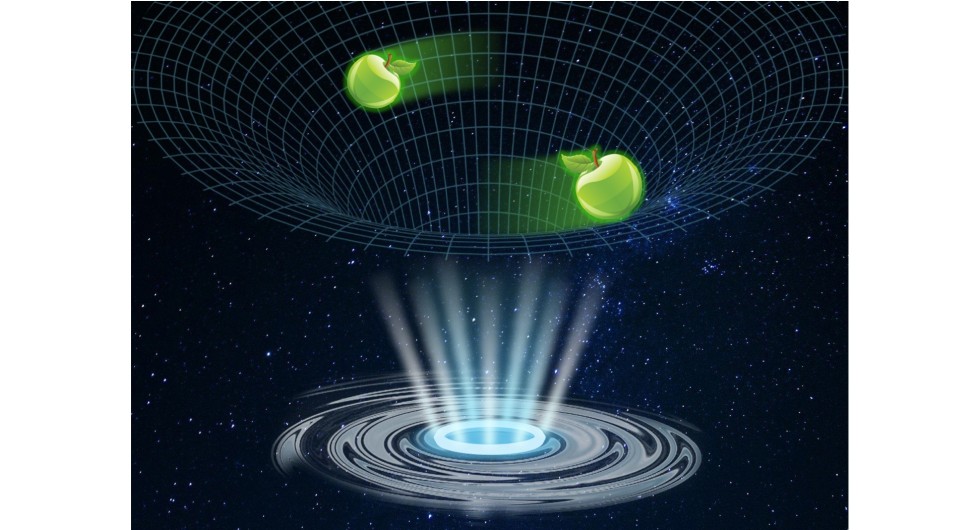 artist's impression of a space-time. Credit: Adrien Fiorucci.
Over a century ago, scientists, led by Albert Einstein, developed the theory of general relativity, which describes the effects of gravity. This theory has enjoyed numerous successes, from Arthur Eddington's confirmation of the deflection of light rays by gravitational effects in 1919 to the first direct detection of gravitational waves, produced by two very massive objects orbiting each other before merging, achieved by the international LIGO and Virgo collaborations in 2015. However, not all the secrets of gravity have yet been unlocked, and physicists are still working on its theoretical formulation.
In an article in Physical Review Letters, CPHT researchers Adrien Fiorucci and Marios Petropoulos, director of research at the CNRS, along with their colleagues Matthieu Vilatte (former CPHT doctoral student, now at the University of Mons) and Simon Pekar (former CPHT postdoctoral fellow funded by the Alexandre Friedmann Fund **, now at the International School for Advanced Studies in Trieste), have developed a formalism that represents gravitational interaction at the “edge” of the Universe.
An “edge” in the mathematical sense
The universe does not have edges in the usual sense, as a desk might have. Nevertheless, using appropriate geometric transformations, it is possible to reformulate its study as that of an object with edges. The space-time described by the theory of general relativity has four dimensions (three spatial dimensions and one time dimension). Its edge has one less dimension, i.e., two dimensions of space and one of time. We can naively imagine this edge as the sky we see at night (the celestial vault): a dome with two spatial dimensions where we cannot distinguish the third dimension, i.e., the distance that separates us from distant stars.
Over the last century, exploration and discovery of numerous properties of gravitational interaction have led to the belief that it would be possible to describe the latter in terms of a theory intrinsically defined on this "celestial vault". From this perspective, the theory of the boundary would be natively three-dimensional and devoid of gravity, making this interaction an emergent force as one moves away from the boundary and into the interior of spacetime. This idea became more concrete in the late 1990s, when renowned physicists such as Gerard 't Hooft, Leonard Susskind, and finally Juan Maldacena laid the theoretical foundations for such a correspondence between gravity “inside” and theory at the edge of space-time, within the formal framework of string theory. It is known as the holographic principle (named after holograms, which project a three-dimensional image when light is shone on a two-dimensional surface), and the questions it raises also motivate this work in Physical Review Letters.
Holography and Physics in Wonderland
Over the past twenty years, the holographic principle has been the subject of considerable research. In the process, it has been verified in numerous different theoretical contexts, but all based on the same model of a negatively curved space-time. While this model is useful for testing the correspondence, it is not suitable for describing the universe in which we live. Indeed, astrophysical observations show that the Universe, on large scales, is almost “flat,” meaning that its curvature is positive but almost equal to zero. The goal of scientists is therefore to investigate a possible extension of the holographic principle to space-times closer to reality and to discuss its mathematical properties.
This is a considerable challenge because, on the three-dimensional boundary, the effective speed of light (but not its actual speed) tends towards zero when the curvature of the four-dimensional interior tends towards zero, according to the equations of general relativity.
"This is exactly the opposite limit to everyday physics, which is Galilean physics, where the speed of light is considered infinite. It is not Einstein's physics either, whose assumption of the finiteness of the speed of light is a major ingredient. It is another, more exotic type of relativity, called Carroll's physics," explains Adrien Fiorucci.
French physicist Jean-Marc Lévy-Leblond was the first to consider this exotic limit of Einstein's relativity in 1965. He named it “Carroll” in homage to the writer and mathematician Lewis Carroll, author of the strange Alice in Wonderland. Building mathematical tools that can be applied to this new physics is therefore a daunting task, and one that the CPHT has made its specialty in recent years, under the leadership of Marios Petropoulos.
Moving towards a unification of gravity and quantum mechanics?
At the edge of space-time, gravitational interaction manifests itself through low-energy effects in which gravitational waves emitted by moving bodies within the Universe play a decisive role.
Einstein's equations predict, on the one hand, that the edge is intrinsically “Carrollian.” On the other hand, they provide the dynamic equations that fundamental quantities, such as energy or angular momentum, must obey when measured by an observer located at the edge.
These equations are relevant at all scales of our understanding of the gravitational field at large distances, and describe with remarkable accuracy the gravitational wave observations made since the first direct detection in 2015.
“We have mathematically rigorously derived the equations that govern the evolution of measurable quantities in the presence of gravitational radiation using geometric tools defined only at the boundary. This is a significant step toward demonstrating a holographic principle in a universe that resembles the one we actually live in,” explains Marios Petropoulos.
If this principle were proven in the future, it would establish a correspondence between gravity as we experience it in everyday life—described today by the theory of general relativity—and as it can be encoded at the edge by a theory in a lower dimension and devoid of gravity. However, researchers have long struggled with the difficulty of unifying gravity with another major branch of physics, quantum mechanics. A correspondence between the boundary and the interior would open up a perhaps more practicable path to reconciling the physics of the infinitely large (shaped by gravity) and that of the infinitely small (subject to quantum mechanics), thus completing an intellectual quest that began 130 years ago. This new perspective could soon lead to new advances.
Reference of the scientific article:
Adrien Fiorucci, Simon Pekar, P. Marios Petropoulos and Matthieu Vilatte, Carrollian-Holographic Derivation of Gravitational Flux-Balance Laws, Phys.Rev.Lett., https://journals.aps.org/prl/abstract/10.1103/qv17-ks32
*CPHT: a joint research unit CNRS, École Polytechnique, Institut Polytechnique de Paris, 91120 Palaiseau, France
** The Alexandre Friedmann Fund is supported by the École Polytechnique Foundation as part of its campaign “Servir la Science,” thanks to the generosity of Romain Zaleski (X 1953).