 Support l'X
How Raindrops Help Plant Reproduction
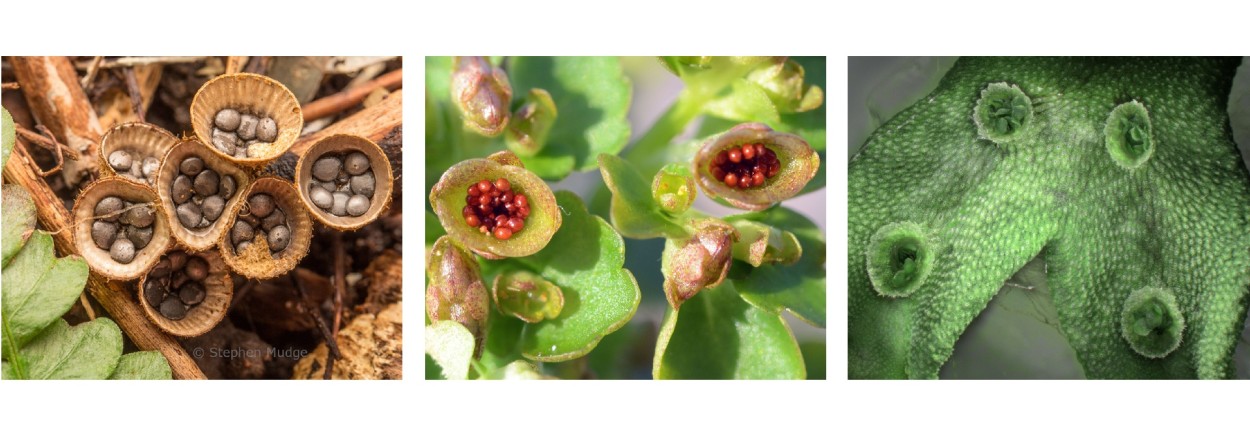 Various species have "splash-cups" structures that house their reproductive units. Shown here are a fungus (left, credit: Stephen Mudge), a flowering plant (center, credit: Shaleen Humphreys), and a liverwort (right, credit: A. Bratu & S. Drevensek)
Over the course of evolution, plants have developed a variety of ways to ensure their survival and colonise new habitats. Some rely on the wind, others on birds or pollinators, and still others on...raindrops. Ana Bratu and her colleagues at LadHyX examined this latter mechanism in a paper published in the journal PNAS.
The Liverwort as a Model
At the heart of this mechanism are small “splash- cups”, specialized reproductive organs, a few millimeters in diameter, found on plants in the bryophyte group, but also present in fungi. “These organisms are very distantly related from an evolutionary standpoint, yet they develop similar structures, posssibly because these structures have proven effective. This is known as evolutionary convergence,” explains Ana Bratu. But what are the details of this mechanism? Scientists had studied this question very little when the researcher began her dissertation three years ago under the supervision of Arezki Boudaoud.
As a model plant, the researchers used Marchantia polymorpha. The principle behind its (asexual) reproduction is simple: at the center of the splash-cups (which are conical inside) are “propagules, ” that is, the plant’s reproductive units, a sort of mini-clone. When rain falls, the drops eject the propagules, which are then dispersed far and wide.
But understanding these mechanisms in detail proves to be complex. Careful observation of raindrops falling onto one of the plant’s cup shows that the water emerges from it as a unidirectional jet, which appears to carry and disperse the propagules. “This is very different from what happens when a drop falls onto a flat surface. The dynamics of a droplet’s impact on a concave surface like these cups were still poorly understood from a fluid mechanics perspective,” the doctoral student points out.
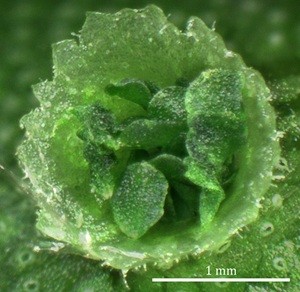
Experiments made with 3D printing
To precisely control the relevant parameters (angle and diameter of the structures, size of the water droplets, and location of the droplet’s impact), the LadHyX team recreated these cups using 3D printing to conduct experiments. At the same time, a kinematical model was developed to explain the mechanism.
When the drop falls on one side of the cup, a jet of water shoots out from the opposite side. The researchers’ explanation: after impact, the water spreads out on either side along the conical walls, following geodesics (that is, the shortest paths). These trajectories converge at the diametrically opposite point, where the water particles collide, producing the jet.

By varying the opening angle of the cups, the team observed two scenarios. If the opening is wide, the jet shoots out horizontally, which is very useful for dispersing plants that spread on the ground. If the cups are narrower, the jet shoots out vertically, which may be advantageous for fungi, as their reproductive units can then attach themselves to plants growing above.
“By moving back and forth between theory and experiment, we’ve identified the angles that optimize the kinetic energy of the jets in these two configurations, and these values are consistent with what we observe in nature!” says Ana Bratu. The team is continuing its research on this topic in partnership with the University of La Réunion to study the effect of the environment on the geometry of these splash-cups.
Reference : A. Bratu, V. Laplaud, A. Garcia, C. Josserand, S. Drevensek, C. Duprat, & A. Boudaoud, Geometry-driven jets underlie dispersal of plants and fungi by raindrops, Proc. Natl. Acad. Sci. U.S.A. 123 (38) e2621491123, https://doi.org/10.1073/pnas.2621491123 (2026).
*LadHyX: a joint research unit CNRS, École Polytechnique, Institut Polytechnique de Paris