 Support l'X
 Listening to Supernovae Background Noise
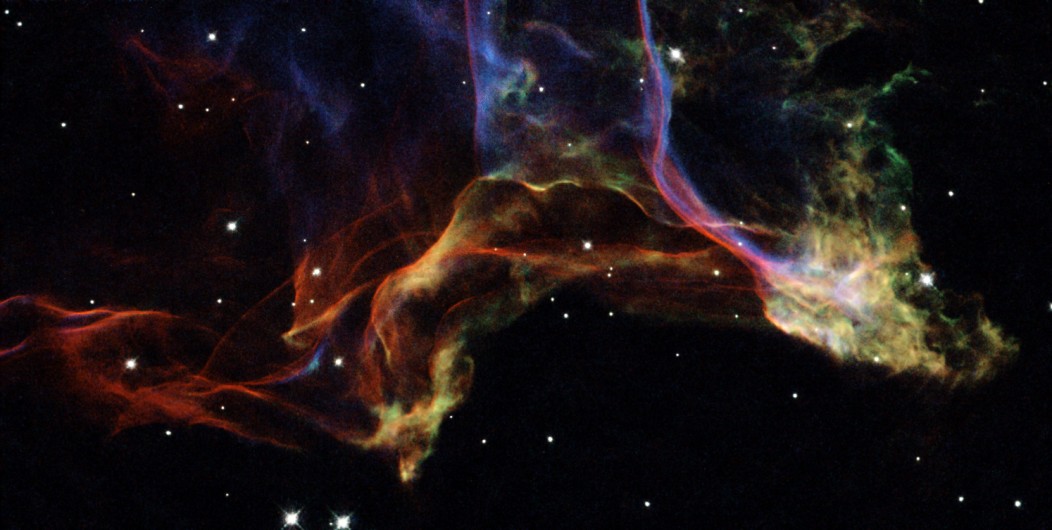 The Veil Nebula is a supernova remnant. Credit: NASA - ESA - Hubble Heritage (STScI/AURA)-ESA/Hubble Collaboration
A large portion of the chemical elements that make up our world were formed in the cores of stars through successive atomic fusions. Some stars, those with more than eight times the Sun’s mass, end their lives as supernovae, that is, a cataclysmic event that ejects all their matter. They leave behind a neutron star or a black hole. They also scatter these elements throughout the universe (creating new ones in the process). Despite ongoing efforts, the mechanisms behind these explosions and their frequency remain largely unknown.
Nevertheless, invisible messengers could provide us with clues. In fact, 99% of the energy from these explosions takes the form of neutrinos, elementary particles. Given all the supernovae occurring in the observable universe, there should be a “shower” of stellar neutrinos, which should be detectable on Earth as a faint background noise.
A massive detector for an elusive particle
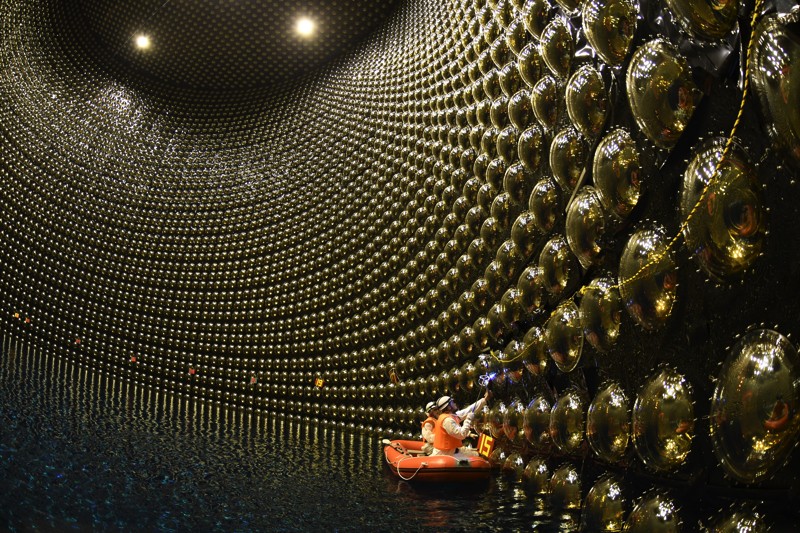
This is one of the goals of Super-Kamiokande, a gigantic tank filled with 50,000 metric tons of water (and a trace of another element, gadolinium) located in Japan. Scientists are primarily looking for particles called electron antineutrinos. When an electron antineutrino arrives, it can interact with a proton in the water. The probability of such an interaction is low, which is why a large volume is needed to increase the chances of observing something. The reaction emits a positron (identical to an electron but with a positive electric charge) and a neutron. The positron emits light as it passes through the water and annihilates with an electron. The neutron is “captured” by an atomic nucleus, which also produces flashes of light. A multitude of sensors placed all around the tank detect these flashes and make it possible to reconstruct the neutrino’s characteristics and trajectory.
At the recent Neutrino 2026 conference, the Super-Kamiokande collaboration announced that it had obtained initial evidence of the existence of the supernova neutrino diffuse background, which is estimated to average 3.6 neutrinos per second per square centimeter (with an uncertainty of plus or minus 1.6). “This result corresponds to a statistical significance of 2.6 sigmas (a confidence level of approximately 99.5 percent) which is below the 5-sigma threshold required in particle physics to declare a confirmed discovery, but we are continuing our observations,” explains Thomas Mueller, a CNRS researcher at the LLR and a member of Super-Kamiokande.
Minimizing errors
The detector, which has been in operation since 1996, has been collecting data for this specific analysis since 2008, demonstrating that patience and meticulousness are essential in this cutting-edge field. In addition to the fact that neutrinos are difficult to detect, the challenge also stems from numerous sources of background noise. Indeed, the Sun, cosmic rays entering Earth’s atmosphere, and nuclear reactions in power plants are all sources of considerable quantities of neutrinos. The challenge, therefore, is to identify the correct signal characteristics in Super-Kamiokande (energy, neutrino type, etc.) in order to minimize the risk of errors.
“We have room for improvement at low energies, where neutrinos from supernovae are more abundant but where there is a threshold below which it becomes very difficult to distinguish them from particles produced in nuclear reactors. We’re trying to lower that detection threshold,” explains Thomas Mueller. This precision work will, within a few years, allow us to learn more about the evolution of the universe.
*LLR: a joint research unit CNRS, École Polytechnique, Institut Polytechnique de Paris, 91120 Palaiseau, France