 Support l'X
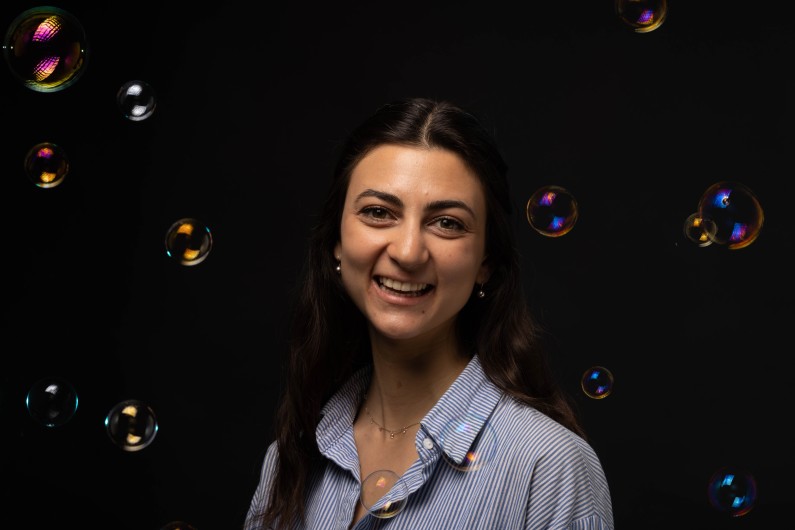
 Margherita Castellano, Math in Bubbles
Why did you choose to study mathematics?
After high school, I was really torn. I liked math, and choosing that path opened up a lot of opportunities. But then I didn't follow a typical path. I started with a bachelor's degree in mathematics applied to economics, then I began a master's program… in public health. But I missed math! I felt like I still had so much to learn. So I switched tracks for my master’s. There’s an aesthetic aspect to this field. Plus, you can’t beat around the bush in math—you have to be direct and concrete.
How did you decide to do your thesis at the CMAP at École Polytechnique?
It wasn’t a goal from the start. At the end of my first year of the master’s program, I did a lab internship that I really enjoyed. I also had the opportunity to take a course at École Polytechnique on Stokes flows. The course particularly interested me, especially the mathematical tools involved (based on differential equations). I also appreciated the instructors, including Flore Nabet, a researcher at the CMAP, whom I asked if it would be possible to pursue a PhD with her. The answer was yes. I am now in my third year of my PhD, with her and Ludovic Goudenège as my advisors.
You begin your presentation for the “My Thesis in 180 Seconds” competition by explaining that your research focuses on soap bubbles. Can you tell us more about that?
One of the objectives is to understand how surface tension—which characterizes the forces at the interface between two fluids (water and air, for example)—is altered by molecules called surfactants, such as soap, which enable the formation and stability of bubbles. Initially, the question was raised with my advisors by physicists regarding a specific problem. In my thesis, I’m trying to find a mathematical model that is both realistic and flexible enough to apply to different situations. But to do that, I have to tackle purely mathematical questions.
What are the main mathematical challenges in your research?
We describe the interactions between fluids and surfactants using Cahn-Hilliard equations. We also include dynamics (such as the effect of currents) using Navier-Stokes equations. Our model consists of a system of differential equations that cannot be solved exactly. I therefore work with approximation methods known as finite volume discretization, which yield a system of equations that can be solved numerically. My work consists of mathematically proving properties of this system. I have thus demonstrated that it does indeed converge to the correct solution. It took me two years to develop this proof! After that, I conducted numerical simulations to implement this method.
What has the PhD program meant to you personally?
First, it has trained me technically. I no longer think the same way I did during my master’s program, for example when first approaching a problem. On a personal level, it has also instilled a certain discipline in me, since you have to be in control of your own time. I’ve also developed greater resilience in the face of difficulty. Often, we explore avenues that don’t work out in the end—that’s normal.
In addition, I’ve had the opportunity to give very enriching presentations with other colleagues in my field of research. Presenting your work allows you to step back and view it in perspective. Finally, I’ve taught in several programs at École Polytechnique and really enjoyed interacting with the students.
Margherita Castellano presenting her thesis in three minutes during the regional finals of the MT180 2026 competition (in French)
* Every year since its launch in 2014, the MT180 competition has aimed to make science accessible to as many people as possible, to introduce the public to ongoing research, to promote doctoral studies, and to train young scientists in science communication. The national finals of the MT180 competition will take place at the Théâtre Sébastopol in Lille on May 28.
CMAP: a joint research unit CNRS, Inria, École Polytechnique, Institut Polytechnique de Paris, 91120 Palaiseau, France