 Support l'X
 Mercury, Jupiter, Saturn... Lina Hadid explores the plasmas of the solar system
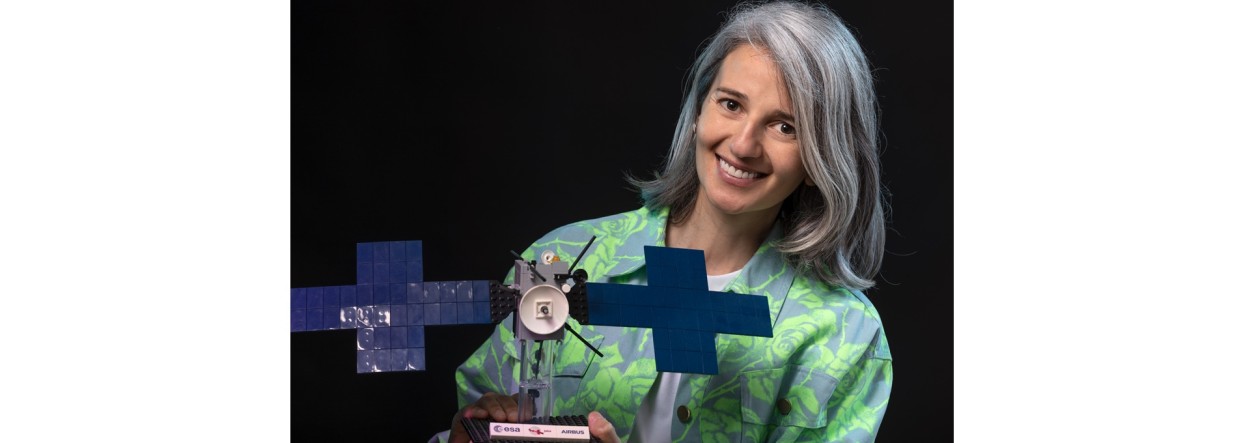 Lina Hadid holding a model of the JUICE probe, a mission currently on its way to Jupiter
What inspired you to pursue scientific research?
When I was very young, many careers appealed to me, cardiologist, painter, jewelry designer..., but later, I became determined to pursue research in physics. I will never forget the partial solar eclipse we observed in Lebanon in 1999. We didn’t have protective glasses to look at it directly, but my father had the idea to use one of the small holes in the wall of our terrace. Through that hole, the image of the Sun was projected directly onto the ground (this is the principle of the camera obscura, or pinhole camera). He encouraged me to take a sheet of paper to trace, draw, and color each stage of the eclipse with a different color. I believe that moment was a true turning point. From then on, I became deeply interested in physics and astrophysics. The idea of being able to observe and study stars, planets, and galaxies so distant that they are invisible to the naked eye fascinated me.
How did you discover the field of plasmas, this state of matter often described as a "soup" made up of electrons and ionized atoms?
I received an Erasmus Mundus scholarship to complete a master’s degree in physical chemistry at Paris-Saclay, with programs in France, Italy, and Poland. I took an introductory course on plasma physics there. Shortly afterward, I attended a summer school where I discovered that plasmas are everywhere, especially in space! Understanding that the solar wind—a stream of particles emitted by our star—is actually a plasma allowed me to connect it to astrophysics. I had found my path. I often tell the students I mentor, especially those with unconventional backgrounds, that it is always possible to find the path that truly excites you.
What is the focus of your research?
I study the interaction of the solar wind with the magnetospheres of planets in our solar system. I particularly enjoy comparative planetology because a planet very close to the Sun, like Mercury, experiences completely different influences than Saturn, Mars, or Earth. These comparisons help us better understand the fundamental processes of plasma physics under different and sometimes extreme conditions. To do this, I analyze data collected in situ by space probes, measurements of particles, electric and magnetic fields, and more. By assembling observations and interpretations like pieces of a puzzle, we create a coherent picture and finally visualize what is actually happening in space. It’s this "explorer" aspect that I love so much.
What is so special about being involved in space missions?
First, space missions operate on very long timescales. For example, I worked on the Cassini mission to Saturn. The probe itself was decommissioned in 2017, but it was launched in 1997, and its design began much earlier! Yet even today, its data remains a goldmine, unique and still being analyzed. In fact, undergraduate students from École Polytechnique are working with me on this topic and have achieved excellent results that we will publish.
Second, what is particularly enriching is the human aspect. A space mission involves hundreds of people collaborating across borders, between laboratories and international agencies. It’s a grand adventure, scientifically, technically, and culturally. It’s truly the teamwork, this collective intelligence, that makes a scientific experiment or discovery successful. Being involved in projects of this scale also teaches us humility and makes us more aware of the modest place our planet and solar system occupy in the Universe.
What current missions are you working on?
This is an exciting time! The BepiColombo probe, a joint mission of the European Space Agency (ESA) and the Japan Aerospace Exploration Agency (JAXA), will enter orbit around Mercury in November 2026. I am the scientific lead for the ion mass spectrometer, whose optics were entirely designed here at LPP, thanks to our expertise in the field. It’s important to remember that laboratories need resources to continue research and develop new instruments for future missions.
At the same time, I am involved in the Solar Orbiter mission (ESA and NASA), currently orbiting the Sun, and the JUICE probe (ESA), en route to Jupiter. I also proposed an ion mass spectrometer for a future ESA mission to Mars, M-MATISSE, which aims to study the impact of the solar wind on Mars. Out of all the proposals received, only three missions were shortlisted, including M-MATISSE! ESA will make its final decision in mid-June 2026. It was an immense workload and mental challenge, but contributing to this project and ensuring the continuity of planetary exploration to pave the way for future generations of students—just as I benefited from when I was a student—is what motivates me every day
*LPP: a joint research unit CNRS, Observatoire de Paris-PSL, Sorbonne Université, Université Paris-Saclay, École Polytechnique, Institut Polytechnique de Paris, 91120 Palaiseau, France