 Support l'X
Mushtic: when mushrooms reinvent eco-friendly packaging
What is the aim of your start-up?
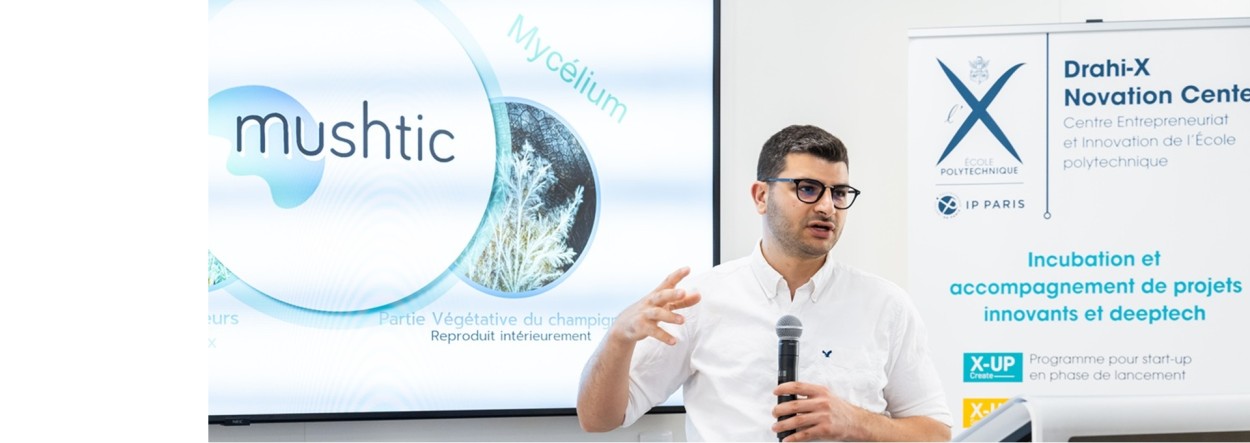
Charbel Sayah, founder and CEO of Mushtic: I want to offer manufacturers an alternative to plastic (polystyrene, synthetic foams, etc.) by drawing on local agricultural resources. To do this, I use a natural binder: mycelium, the vegetative part (the roots) of fungi. Using this, I transform agricultural by-products into 100 per cent natural and compostable biomaterials, which are resistant to impact, fire and moisture… and do not generate any additional waste. On the contrary, they can be used to enrich the soil. It is therefore an environmentally friendly and self-sufficient alternative. Indeed, Europe imports 94.9 per cent of its oil. However, Mushtic’s aim is also to reduce our dependence on petrochemicals by supporting the work of local farmers.
Where did this idea come from?
Firstly, from an observation, and then from a desire to make a positive contribution to society following some personal hardships.
In 2015, Lebanon, my country of origin, was facing a major waste management crisis. Its capital, Beirut, was overwhelmed by rubbish. I saw this as an opportunity to manage waste more effectively, particularly as the negative impact of polystyrene on the environment and health was becoming increasingly apparent.
On a personal level, my father’s death led me to take on greater responsibilities within the family fruit farm. As an agronomy student, I simultaneously began conducting research to try to find an alternative to polystyrene. I carried out tests at home and in the laboratory at my university, USEK (Holy Spirit University of Kaslik). I asked myself: ‘What material could be used?’; ‘What were the market’s needs?’; ‘What applications were possible?’. This approach enabled me to secure letters of intent from two multinational companies. Unfortunately, the global and national situation has become more complex due to a series of major crises: the Covid-19 pandemic; the socio-economic crisis in Lebanon; and the explosion at the port of Beirut, where I lost loved ones.
These disasters strengthened my determination to serve society and help others. I joined an NGO in Lebanon that uses plant-based therapies and reconnection with the earth as therapeutic tools to support people’s mental health.
I had always aspired to work with bio-based materials. Furthermore, my research had attracted the interest of European universities. I first went to the Netherlands, where I studied bioplastics at Maastricht University, before moving on to the European Silicon Valley: Paris-Saclay.
I was immediately captivated by France, both for the richness of its natural and gastronomic heritage and for its industrial excellence, its dynamism in research and its commitment to the environment.
I was looking for an organisation recognised by French Tech where I could develop prototypes whilst working at the heart of an ecosystem combining entrepreneurial spirit, cutting-edge research and an industrial mindset. From that point on, joining the 16th cohort of École Polytechnique’s incubator, X-UP, was the obvious choice.
Tell us more about your experience at X-UP, Ecole Polytechnique’s incubator
From October 2023 to July 2024, I was part of a cohort of start-ups incubated at X-UP on the Polytechnique campus.
For nine months, I was supported by a start-up manager. Their personalised guidance was invaluable in helping me progress in my entrepreneurial journey.
In addition, I attended masterclasses and received targeted advice on market research and intellectual property…
The resources of the X-Novation Center were also made available to entrepreneurs, such as the X-FAB prototyping space, the E4H LivingLab (a creative and collaborative space dedicated to prototyping bioengineering projects) and the co-working space.
Thanks to this comprehensive support, I set up my company, Mushtic, on 28 June 2024. The name is a portmanteau of the words ‘mushrooms’ and ‘plastic’. It is a semantic nod to mushrooms replacing plastic.
What’s next ?
Recruiting a partner with an engineering background that complements my own – in other words, an industry expert who understands the entire factory supply chain and has experience managing teams on the ground, as well as a flair for entrepreneurship. He’s due to join Mushtic this month!
At the moment, I’m focusing on producing bespoke prototypes to meet the specific needs of our prospective clients in sectors such as logistics, packaging, construction and interior design. My short-term goal is to turn these discussions into letters of intent and pre-orders.
Furthermore, I’d like to carry out a second round of fundraising, which would give me the means to strengthen the Mushtic team with further strategic hires.
What advice would you give to a would-be entrepreneur?
To ensure your business’s long-term viability, you need to understand your market and address a fundamental issue rather than simply following a trend.
On a more personal note, I would add that committing to a project that makes a difference helps you overcome the challenges you face as an entrepreneur. In my view, it is essential to be able to tell my children one day that I have contributed, in my own small way, to bringing about positive change in our value chain.