 Support l'X
 Particle Acceleration and Floating Laboratory at École Polytechnique for European Researchers’ Night
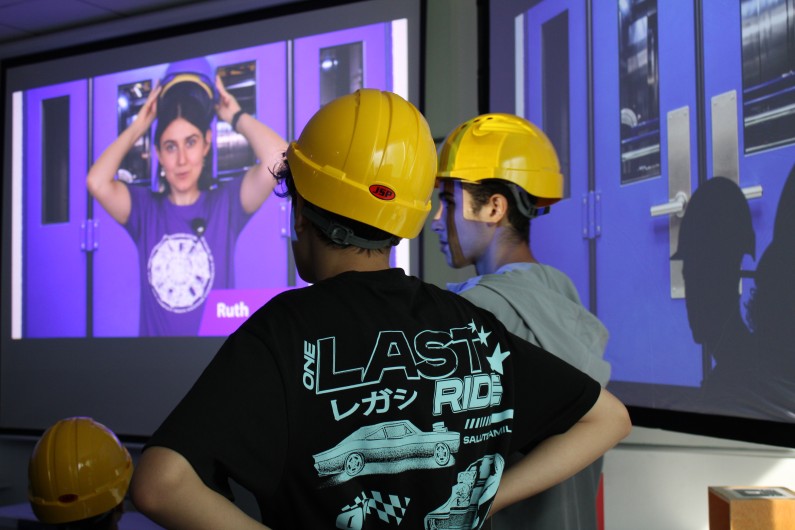 High school students listening to instructions on how to enter CERN’s virtual campus during the escape game organized by the Leprince-Ringuet Laboratory (LLR).
This Friday, September 25, several laboratories at École Polytechnique welcomed high school students for the European Researchers’ Night. Supported by the Marie Skłodowska-Curie Actions, an initiative of the European Commission, this annual event aims to give participants a behind-the-scenes look in laboratories and offer them an opportunity to get involved in cutting-edge scientific projects.
With support from École Polytechnique’s Equal Opportunity Office and their “Les cordées de la réussite” program, high school students from Saint-Denis and Argenteuil were able to visit several basic science laboratories at École Polytechnique and directly ask researchers their scientific queries. The first stop was the Leprince-Ringuet Laboratory (LLR), the school’s oldest laboratory and a global pioneer in particle physics. The goal: to gain a basic understanding of the world of elementary particles through a brand-new interactive escape game.
The typical goal of an escape game is to solve mysteries and puzzles using an interactive environment, drawing on critical thinking and logic to conduct an investigation until the solution is found. At the LLR, students were tasked with determining the mass of an elementary particle, the Higgs boson, whose discovery in 2012 marked the final major milestone in validating our Standard Model of particle physics. To do this, the game places them in a virtual version of CERN (located in Geneva, Switzerland), specifically within the Large Hadron Collider (LHC). From there, challenges and puzzles allow players to resolve a dire situation involving a lecturer in desperate need while on his way to Stockholm and the Nobel Prize...
This activity, which combines mathematics and the popularization of particle physics, is made possible by the ERNEST (European Researchers’ Night Escape Science Team) project, which aims to introduce participants to the scientific method through escape games. The scenario and the project were created by the Italian National Institute of Nuclear Physics, with support from CERN, and were adapted by LLR research staff using dedicated funds that enabled the purchase of the equipment needed to set up this escape game.
During this day-long event, students also had the opportunity to get a sneak peek at a future floating experimental platform, XSeaO2, on the École Polytechnique’s lake. Currently nearing completion, this cutting-edge platform is intended to serve as a research demonstrator dedicated to capturing atmospheric CO2 and producing synthetic fuels from CO2 dissolved in water.
Finally, it was also an opportunity for these aspiring scientists to tour the facilities at the Molecular Chemistry Laboratory (LCM) and talk with researchers about the world of research and the related scientific careers.