 Support l'X
 Portrait of Ortensia Forni, PhD student in Color Perception
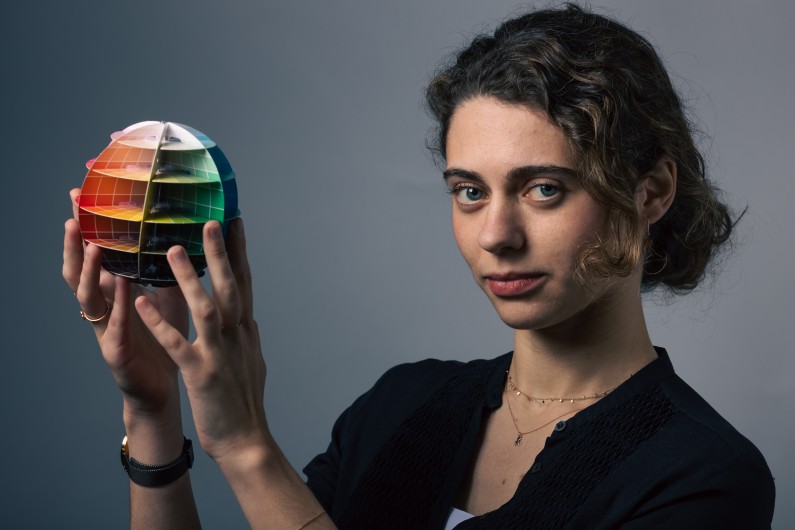 Ortensia Forni, doctoral student at the EconophysiX Lab. © Jérémy Barande
1. Can you introduce yourself and tell us about your scientific background?
My name is Ortensia and I am a first-year doctoral student at LadHyX, under the supervision of Michael Benzaquen and Alexandre Darmon. I began by studying mathematics in Milan, then moved on to applied mathematics in Turin. To complete my master's degree, I did an internship at the EconophysiX Lab at Ecole Polytechnique in France, where I studied color combinations in images and how they are perceived by people.
This internship sparked my interest in research and led me to pursue a PhD. I really enjoy the challenge and freedom that scientific research offers, and working in an interdisciplinary lab with a stimulating team and supportive supervisors has meant a lot to me.
2. Can you summarize your research on color harmony?
We started by asking more than 300 participants to evaluate pairs of colors to identify those that are considered most pleasing. Our results show that certain colors, such as blue or yellow, are perceived as more harmonious, and that these preferences correspond to colors that occur very frequently in nature. We found that the same can be said for pairs of hues, suggesting that there may be universal trends in our appreciation of colours and their combinations.
3. How did you design your experiments and integrate mathematics into this project?
We used quantitative methods, such as Principal Component Analysis, to compare the color combinations evaluated by participants with those found in nature. Each color pair was translated into a positive index if it was judged mostly as pleasant, or a negative index if it was less appreciated.
We also calculated the frequency of hues in natural images and analyzed the chromatic distance between colors. By comparing these data, we observed a significant correlation: the color combinations most appreciated by participants correspond on average to the combinations most frequently found in nature.
These mathematical measures have enabled us to quantify perceived harmony and demonstrate a concrete link between human preferences and the colorimetric statistics of our environment.
4. What do your findings teach us about human color perception?
Our findings suggest that human perception of color harmony is deeply influenced by our natural environment. Colors surround us constantly, and we tend to associate them with our daily lives without even realizing it. These observations offer new perspectives for art, design, and even the psychology of perception.
5. What advice would you give to young women wishing to embark on a career in scientific research?
Personally, I have found that creativity is not incompatible with scientific rigor: on the contrary, it can be enriched by a quantitative approach. And as a woman working in a field that is still predominantly male, it is important to believe deeply in your own abilities, not let discouragement hold you back, and to dare to embark on ambitious projects.
*LadHyX: a joint research unit of the CNRS, École Polytechnique, Institut Polytechnique de Paris, 91120 Palaiseau, France.