 Support l'X
 The “Space: Science and Spatial Challenges” Chair Celebrates Its Technological Ambitions
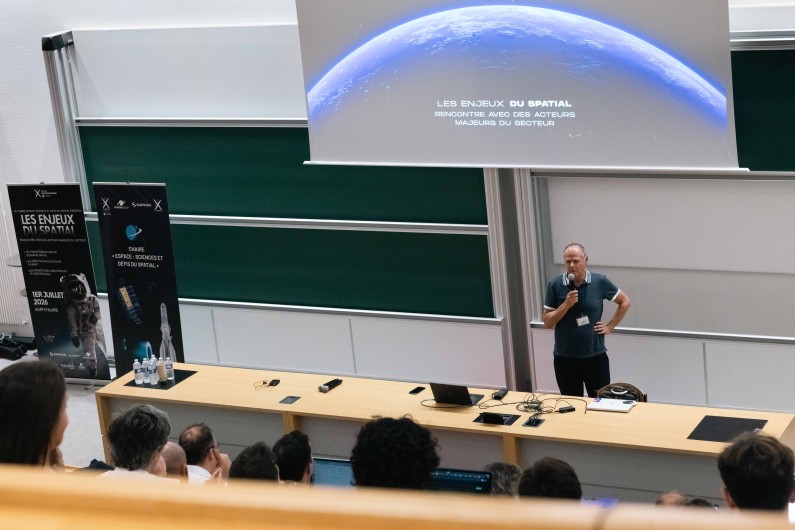
Established in 2019, École Polytechnique’s “Space: Science and Spatial Challenges” Chair aims to train the aerospace professionals of tomorrow. Combining space projects with cutting-edge science courses, this chair also offers students and researchers a window into the French industry, as demonstrated by this half-day event dedicated to the major challenges facing the space sector on Wednesday, July 1. This event provided an opportunity to bring together and give a platform to key players in the French and European space industries, in a series of lectures open to all students and research staff at École Polytechnique.
A Chair with Big Ambitions
Pascal Chabert, the Chair’s current representative, presented the activities and ambitions the Chair has pursued since 2019, which have notably led to the creation of an Advanced Studies Program for third-year students in the Polytechnique Engineering Program, featuring courses specifically related to space. This curriculum allows students to prepare for a potential fourth year in specialized programs, such as those at ISAE-SUPAERO.
The École Polytechnique Space Center, open to second-year students, now has four full-time engineers and new equipment that enables it to undertake highly ambitious projects, such as IonSat—a professional satellite project supported by CNES and the Fondation de l’X, scheduled for launch in 2027. This new equipment also includes an S-band antenna on the Saclay Plateau campus, funded by the Île-de-France Space Academy, which provides the Center with mission control capabilities.
An Exceptional Gathering of Leading Figures in the Space Industry
To celebrate the chair’s progress, patrons and supporters of the Founders’ Chair came together to form a panel of high-level speakers:
- Hervé Gilibert, CTO of ArianeGroup
- Christophe Valorge, CTO of Thales Alenia Space
- Lionel Suchet, Director General of CNES
- Romain Lucken, CEO of Aldoria
- Jean-Marie Bétermier, Director of Safran Espace
In short presentations, each speaker addressed the challenges, projects, and ambitions currently shaping the space sector, offering the audience a comprehensive overview of the field’s current issues: technological innovation, sovereignty, new applications, and future prospects.
Hosting executives from the leading French space industry players all at once is a significant achievement for the Chair and reflects the recognition it has earned from the industry, having benefited from the consistent support of its sponsors: from 2019 to 2024, Thales and ArianeGroup; and, from 2024 through 2029, Safran and ArianeGroup.
A Future in the Stars
The day concluded with remarks by Anne Bourdon, a CNRS research director at the Ecole Polytechnique’s Plasma Physics Laboratory, who is taking over as chairholder. Like Pascal Chabert, she outlined the Chair’s achievements, the Space Center’s current and future projects, and the goals she has set for herself, with a focus on developments related to scientific research. She also highlighted what the Chair enables and offers students, particularly the training week at CNES, organized exchanges with sponsors, and company visits, emphasizing the Chair’s educational and training aspects.
In just seven years, the “Space: Science and Space Challenges” Chair has established itself as an essential bridge between academia and industry, nurturing the talent of tomorrow while spearheading concrete projects such as IonSat. With the continued support of its sponsors and under the leadership of Anne Bourdon, it is now writing a new chapter in its history—and in the history of the French space sector.