 Support l'X
 Three female researchers from École Polytechnique win the 2026 L'Oréal-UNESCO For Women in Science Award
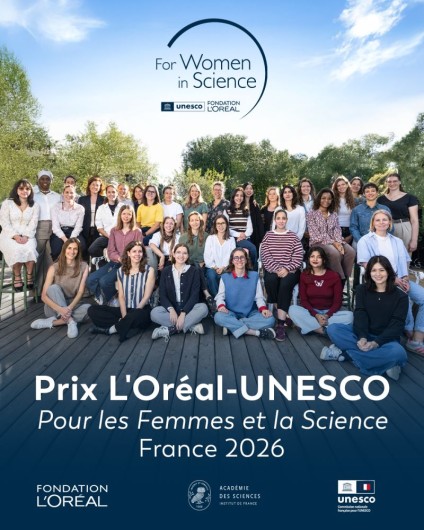
The Ecole Polytechnique is proud to have three female researchers among the 35 winners of the 2026 edition: Kate Sorg, PhD student at the Laboratory of Optics and Biosciences (LOB*, CNRS, INSERM), Sonia Mazelet, PhD student at the Center for Applied Mathematics (CMAP*, CNRS), and Johanna Loyer, a postdoctoral researcher at the École Polytechnique Computer Science Laboratory (LIX*, INRIA).
The Ecole Polytechnique would also like to congratulate four of its alumni receiving the same distinction this year: Justine Duval (X2019), Marie-Anne Carpine (PhD Paris-Saclay, X2019), Brune Massoulié (PhD, X2019), and Maëlys Solal (Polytechnique Bachelor’s degree). This is a wonderful recognition of their talent and the progress they have made since completing their studies at École Polytechnique.
Sponsored by the L'Oréal Foundation, UNESCO, and the French Academy of Sciences, the L'Oréal-UNESCO For Women in Science France Award honors young female researchers for the excellence of their work. This award aims to encourage them and provide them with the resources to continue pursuing their passion for research. Beyond scientific recognition, the award also seeks to increase the visibility of women in science.
The Winners

Kate Sorg’s dissertation focuses on the study of atypical forms of DNA in microorganisms living in extreme environments. For the first time, her work demonstrates the presence of these forms of DNA in archaea, thereby proving their existence in all groups of living organisms. It also suggests that these structures could be universal regulators of the functions performed by DNA.
This area of research paves the way for promising applications in the fields of health and biotechnology: “Several cancer treatments that specifically target these DNA structures are currently in clinical trials. Furthermore, these extremophiles play a major role in biotechnology,” explains Kate Sorg, a PhD student at the École Polytechnique’s Laboratory of Optics and Biosciences (LOB).
She conducts her research in an environment she finds particularly stimulating: “The LOB is a large laboratory, an environment that is both supportive and international, which helps a lot—both as a student and as a foreigner. I feel really comfortable there with my colleagues. Ability is never an issue here, and certainly not in relation to being a woman. It’s simply not the question: we start from the premise that everyone is capable, and the real question we ask ourselves is how we’re going to make it happen.”

Sonia Mazelet’s dissertation research aims to apply artificial intelligence to the analysis of brain data. To do so, she is developing a deep learning algorithm that compares complex brain data from multiple individuals (taking their unique characteristics into account) and transforms it into representations that are easier to analyze.
At the intersection of mathematics, artificial intelligence, and neuroscience, this research aims to make better use of functional magnetic resonance imaging (fMRI) data to understand the brain’s geometry and connections and to decode its activity.
These findings could “help study the brains of many people to better understand certain diseases or differences between individuals,” said Sonia Mazelet, a doctoral student at the Center for Applied Mathematics (CMAP).
These advances could also have applications in other fields, particularly biology and chemistry.
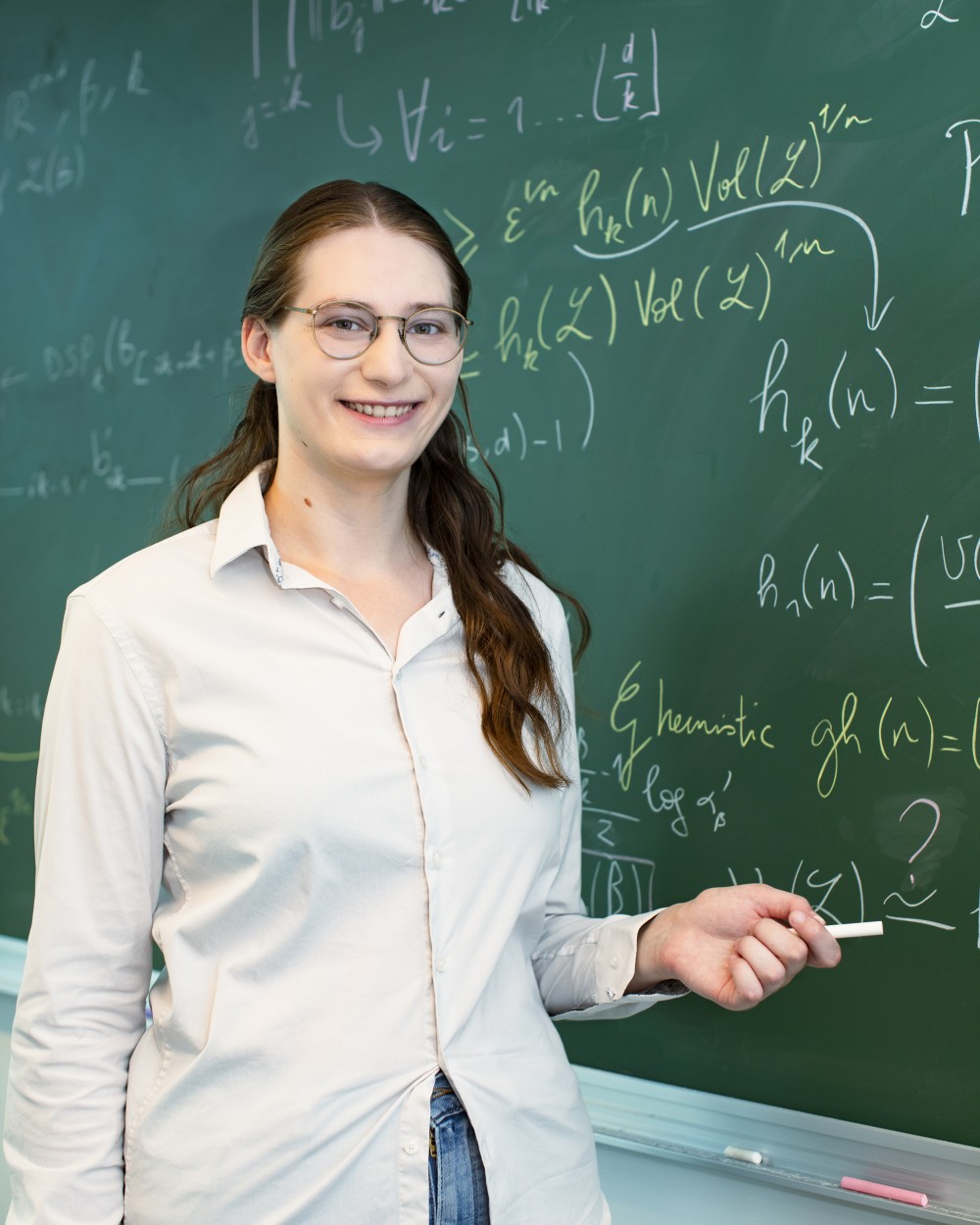
Johanna Loyer's work addresses a major challenge of our time: “We all use encryption every day, for example when we pay with a credit card or make an online purchase: it secures our transactions and protects our personal data. Current systems will be vulnerable to future quantum computers, which are far more powerful machines.” .
Her research, at the École Polytechnique’s Computer Science Laboratory (LIX), thus aims to evaluate the robustness of new encryption systems designed to withstand attacks from future quantum computers. In particular, she is studying two mathematical problems upon which several post-quantum cryptography mechanisms are based: the short vector problem (SVP) and the decoding problem.
*CMAP: a joint research unit of the CNRS, École Polytechnique, and the Institut Polytechnique de Paris
*LOB: a joint research unit of the CNRS, INSERM, École Polytechnique, and the Institut Polytechnique de Paris
*LIX: a joint research unit of the CNRS, INRIA, École Polytechnique, and the Institut Polytechnique de Paris