 Support l'X
 Collaboration investigates collective effects of electrons
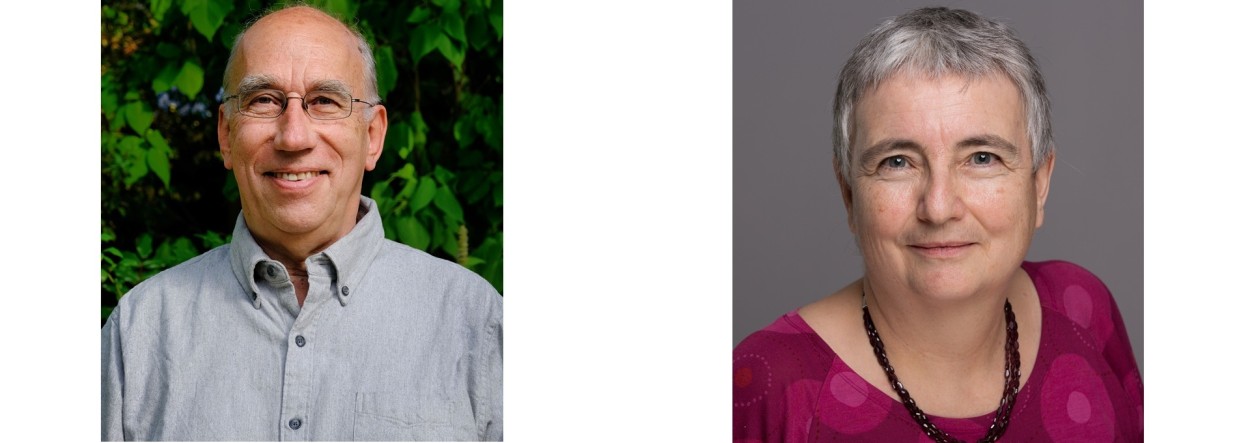 Eberhard Gross et Lucia Reining
If you ask a physicist what colors of light a single hydrogen atom can emit or absorb, the answer will not be too difficult. With only one proton and one electron, hydrogen is a textbook example in quantum physics courses. For a helium atom (two protons and two electrons), the calculation can be performed by a computer. But as the number of particles increases, the calculation becomes more complicated. “Imagine we had a way of calculating the full wave function of an aluminium atom (13 electrons) and wanted to store the information contained in the wave function on standard SSDs. It is easy to see that the mass of SSDs necessary for this job would exceed the mass of the earth, and for a titanium atom (22 electrons) the mass of necessary SSDs would exceed the mass of the observable universe,...clearly a problem" points out Eberhard Gross.
During his career, this theoretical physicist developed powerful approaches to overcome this problem and accurately calculate the properties of matter. Now affiliated with the Tsientang Institute of Advanced Study (China), Eberhard Gross is currently a Gaspard Monge visiting professor at École Polytechnique, at LSI, in the Theoretical Spectroscopy group coordinated by Lucia Reining.
Quantum mechanical many-body problem
The puzzle raised by the behavior of many interacting particles is known as the quantum mechanical many-body problem. "One of the reasons this problem is so complex is that it is not a matter of adding up the individual behaviors of the particles to understand the system as a whole. There are collective effects that can create surprises," explains Lucia Reining. This is undoubtedly why, for example, the superconductivity (i.e. the ability to conduct electricity without loss below a certain temperature) of some materials such as cuprates remains a mystery.
To determine the quantum properties of a material, one must in principle calculate its “wave function,” a mathematical object given by the equations of quantum physics. “But this is incredibly difficult when there are many interacting particles,” explains Eberhard Gross. "We can try to formulate the properties to be calculated in terms of other objects that are easier to calculate, such as the electron density. "
This is the principle behind density functional theory, which earned Walter Kohn the Nobel Prize in Chemistry in 1998. Eberhard Gross extended this theory to cases where the physical system evolves over time, for example when particles are illuminated by light.
A fruitful dialogue
As for Lucia Reining, she develops new methods to express properties of materials in terms of Green's functions, another approach to tackling the quantum mechanical many-body problem. How do these two approaches compare and complement each other? How can they be used to develop better calculation methods and deeper understanding? This dialogue is one of the goals of Eberhard Gross’s visit to the LSI. “This is the first time we've really had the opportunity to work together, but we already have a long tradition of discussion.” Much of this is thanks to the workshops organized within the European Theoretical Spectroscopy Facility (ETSF), of which both physicists are members.
During this stay, the two scientists are specifically trying to further develop the method of exact factorization (another approach proposed by Eberhard Gross), by combining it with the Green’s functions formalism. "If we take the equation that governs the behavior of a molecule or a solid, we can prove that the wave function can be written as a product of two wave functions, one for the electrons and the other for the nuclei, leading to two interdependent equations” explains Eberhard Gross, who also plans to use this method to understand the phenomenon of quantum decoherence, whereby the interaction of particles with their environment annihilates their quantum properties, which is one of the barriers to the creation of a scalable quantum computer.
During a second six-month stay at the end of the year, Eberhard Gross will give a course on these subjects to students and researchers at École Polytechnique.
*LSI: a joint research unit of CEA, CNRS, École Polytechnique, Institut Polytechnique de Paris, 91120 Palaiseau, France