 Support l'X
 Hugo Duminil-Copin at L'X: Mathematics as a Dynamic Science
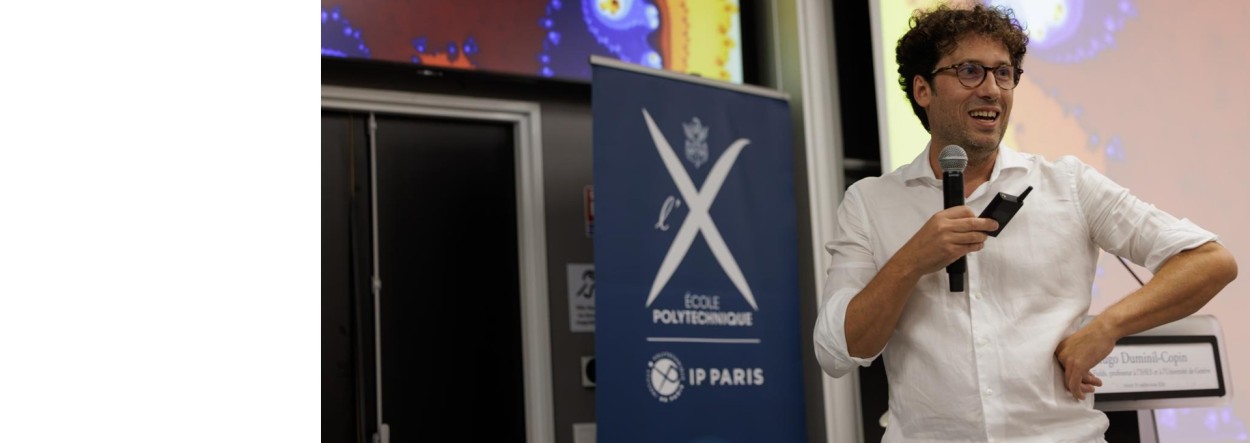
“Mathematics should no longer be seen as an exclusive territory reserved for a select few.” In welcoming Hugo Duminil-Copin to École Polytechnique, Bruno Bellier, Acting President and CEO of the École, emphasized the importance of making mathematics more accessible and of better understanding the processes that lead to discovery and knowledge.
A specialist in probability theory and statistical physics, Hugo Duminil-Copin is a professor at the University of Geneva and the Institut des Hautes Études Scientifiques (IHES). He was awarded the Fields Medal in 2022. In De l’autre côté du tableau noir – Les mathématiques à visage humain, co-authored with psychologist Emmanuel Sander, he explores how emotions, intuition, curiosity, and the willingness to make mistakes can contribute to learning mathematics.
Speaking to students and members of the École’s leadership, Duminil-Copin chose to focus on the process of doing mathematics rather than solely on its results. His own experience illustrates this approach. After struggling at the beginning of his scientific studies at the Louis-le-Grand high school in Paris, he says he made progress by drawing in particular on his experience in sports: repetition, perseverance, accepting mistakes, and the ability to question and adapt his learning methods.
Mathematics: a longstanding scientific tradition at École Polytechnique
Duminil-Copin’s perspective on how mathematics is learned and practiced resonates particularly strongly at École Polytechnique. Since its foundation in 1794, the École has placed mathematics and the fundamental sciences at the heart of its scientific education. Combined with engineering, this rigorous training is a defining feature of the École’s identity and reflects a longstanding scientific tradition, whose early figures include Gaspard Monge, one of the founders of École Polytechnique.
The history of École Polytechnique is closely intertwined with the development of mathematics over the past two centuries. Numerous faculty members and alumni have contributed to the advancement of the discipline, including Henri Poincaré, Augustin-Louis Cauchy, Fields Medalist Laurent Schwartz, Abel Prize winner Yves Meyer, Fields Medalist Pierre-Louis Lions, and Fields Medalist Alessio Figalli. More recently, Hong Wang received the Breakthrough Prize, while Stéphane Mallat was awarded the CNRS Gold Medal.
At École Polytechnique, mathematics also maintains close connections with other scientific disciplines. Its development has gone hand in hand with advances in physics, life sciences, materials science, and operations research. Changes in the discipline and its applications are also reflected in the École’s teaching, from applied mathematics to machine learning and artificial intelligence, as well as in major areas of fundamental mathematics.
Intuition and creativity at the heart of mathematical research
For Hugo Duminil-Copin, however, the history of mathematics cannot be reduced to a succession of theories and results. Mathematical practice also draws on intuition, analogy, and mental representations. “When you do mathematics, the way you think is the same as the way you think in everyday life,” he explained, emphasizing the role of these mechanisms in understanding and creativity.
This perspective gives an important role to individual experience and collective work. According to Duminil-Copin, individual skills and intuitions can complement one another in research, while mistakes and difficulties are an integral part of the scientific process. “Research in mathematics can involve years of wandering,” he noted, stressing the importance of enjoying the process of discovery and being willing to challenge one’s initial intuitions.
Duminil-Copin’s lecture thus brought together two dimensions of mathematical practice: a discipline grounded in rigor and proof, but also a human activity in which intuition, creativity, experience, and collaboration play an essential role. This vision echoes the tradition of École Polytechnique, where mathematics is at once a cornerstone of education, a major field of research, and a tool for addressing complex scientific challenges.
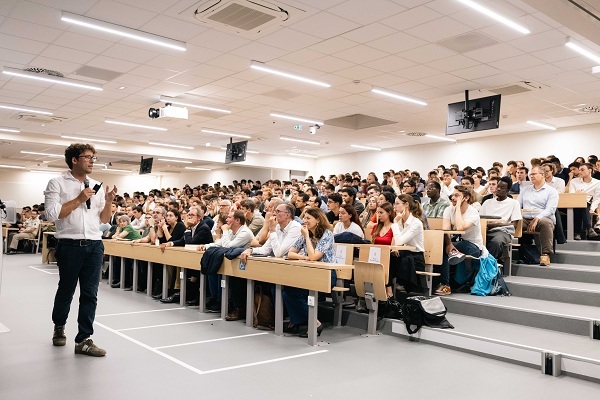 Le mathématicien Hugo Duminil-Copin © Jérémy Barande, École polytechnique
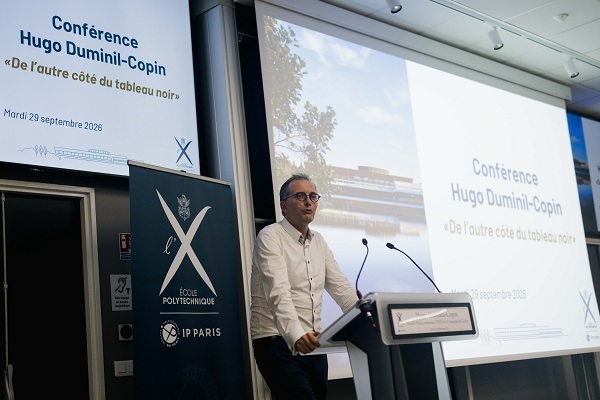 Bruno Bellier, président par intérim et directeur général de l’X © Jérémy Barande, École polytechnique
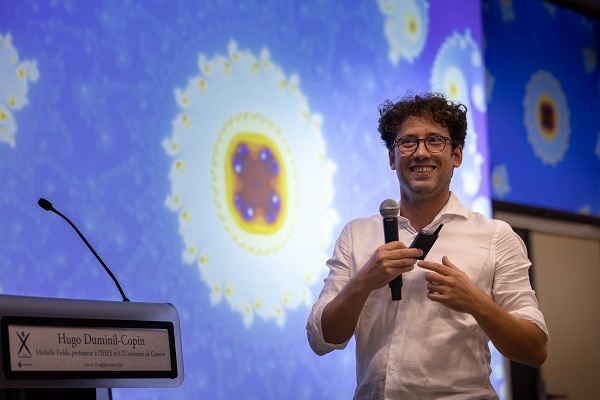 © Jérémy Barande, École polytechnique
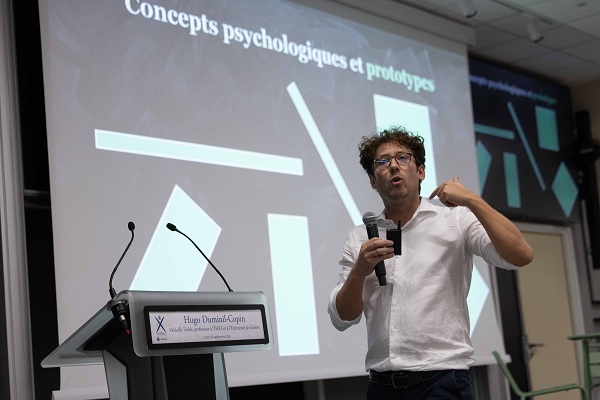 © Jérémy Barande, École polytechnique
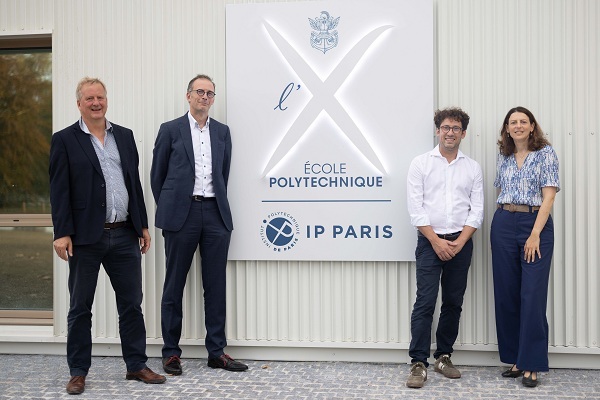 (De gauche à droite) Kees van der Beek, directeur de la recherche de l'X ; Bruno Bellier ; Hugo Duminil-Copin ; Laura Chaubard, ancienne présidente par intérim et directrice générale de l’X © Jérémy Barande, École polytechnique