 Support l'X
 Portrait of Inass El Hajj, a postdoctoral researcher in the chemistry of carbon nanomaterials
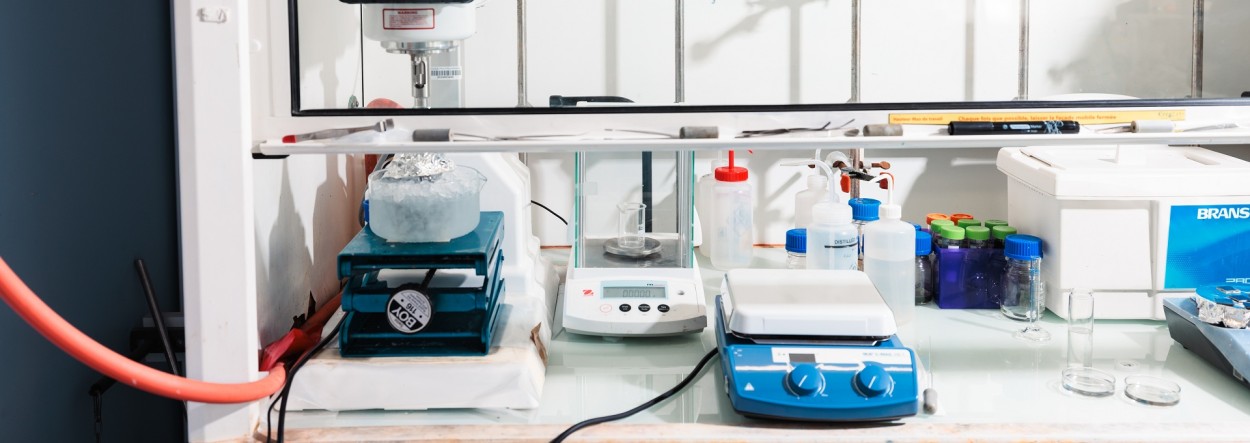 Research by Inass El Hajj, postdoctoral researcher at LPICM. © Jérémy Barande
1. Could you introduce yourself and tell us about your academic background?
My name is Inass El Hajj. I am of Lebanese origin and studied general chemistry, specialising in molecular and inorganic chemistry. My interest in research was sparked during a five-month internship at Aix-Marseille University, focusing on TiO₂ nanotubes for biomedical applications, which marked my first foray into the field of nanomaterials and research in France.
I then completed a PhD at the Jean Lamour Institute, working within a team specialising in carbon materials. In 2022, I began my first postdoctoral fellowship at Gustave Eiffel University in collaboration with École Polytechnique and the University of Paris-Est Créteil, funded by the MMCD Labex, focusing on the synthesis of graphene in the liquid phase and its application to the protection of aluminium against corrosion in marine environments. I am currently continuing this work as part of a second postdoctoral fellowship supported by the Sustainable Energy Chair at LPICM-École Polytechnique, focusing on the protection of stainless steel in marine environments.
2. Why did you choose to work on graphene and carbon nanomaterials?
Graphene has been a fascinating material since its discovery in 2004. A single layer of graphene consists of a layer of carbon atoms arranged in a hexagonal honeycomb lattice. It forms the basic unit of graphite, which is made up of several layers stacked in a well-defined structure. This atomic structure gives graphene exceptional properties: it is an excellent electrical and thermal conductor, highly mechanically resistant, flexible and transparent, whilst possessing remarkable chemical properties.
From my very first internship, I was drawn to the world of nanotechnology and subsequently to carbon, a fundamental element that is the basis of life and ubiquitous in our environment. Working on carbon-based materials represented a unique opportunity for me to explore a vast scientific field, one that is both fundamental and rich in applications.
3. Why focus specifically on the marine environment?
The marine environment is particularly corrosive to metals, due to the presence of salt – and specifically chloride ions – which significantly accelerate corrosion. Materials such as aluminium and stainless steel, although widely used, can be damaged under these conditions.
The aim of my research is therefore to develop effective protective coatings capable of extending the service life of materials exposed to these harsh environments. This issue is particularly important for structures related to marine renewable energy, where the durability of materials is a major challenge from both an economic and environmental perspective.
4. What experimental methods do you use on a daily basis?
A typical day begins with the synthesis of graphene nanosheets, followed by their purification and quality testing in solution. The material is then characterised, collected as a powder, and subsequently diluted in an aqueous solution. The graphene is then deposited as a coating via self-assembly onto metal substrates.
I study the coating’s adhesion and morphology, and verify that the quality of the graphene remains unaffected (thickness, continuity, absence of defects). Finally, electrochemical measurements, which may take several weeks, are used to assess the effectiveness of the corrosion protection.
5. What are the benefits of conducting research within a chair funded by a company?
Working within the framework of a Chair allows us to be part of an applied research approach, with concrete prospects for putting the results to use. It is particularly motivating to know that our work can address real needs, help businesses and, indirectly, benefit society.
In my case, contributing to the protection of materials in the marine environment supports the development and reliability of renewable energy infrastructure, a key challenge for the green transition.
6. What advice would you give to young female researchers wishing to specialise in materials and nanomaterials?
Research is, above all, a journey of scientific discovery and personal development. You mustn’t be afraid to tackle new challenges: you’re constantly learning. Team spirit is also essential. I’ve been lucky enough to work in very welcoming teams, with supportive supervisors.
Networking, discussions with members of my thesis committee, collaborations and the scientific community play a key role in a career. Finally, I would say that you mustn’t be afraid of failing, nor of asking for advice, whether on a personal or academic level.
*LPICM: a joint research unit of the CNRS, École Polytechnique and Institut Polytechnique de Paris, 91120 Palaiseau, France