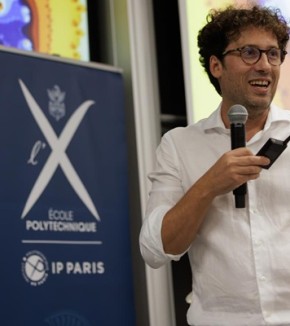
Fields Medalist Hugo Duminil-Copin visited École Polytechnique to share his perspective on learning and practicing mathematics, drawing on his book De l’autre côté du tableau noir – Les mathématiques à visage humain (On the Other Side of the Blackboard – Mathematics with a Human Face). The event also provided an opportunity to highlight the central role mathematics has played throughout École Polytechnique’s history and in shaping its scientific identity.
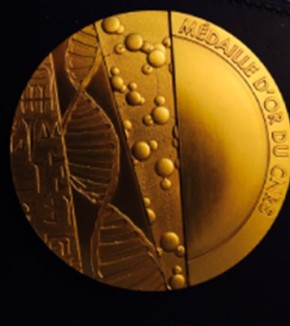
This award recognizes a career dedicated to the study of quantum phenomena and the development of new experimental approaches in physics. Jacqueline Bloch, a CNRS research director at the Center for Nanoscience and Nanotechnology (C2N)—a joint CNRS-Université Paris-Saclay unit—is also a member of the French Academy of Sciences.
Among the over 3,220 students enrolled at École Polytechnique for the academic year 2026-2027, more than 40 % are international. Admitted to the various degree programs at l’X due to their academic and scientific excellence, they come from around the world to pursue their studies at l’X this year. A diversity of nationalities and backgrounds that enriches the experience for everyone on campus.
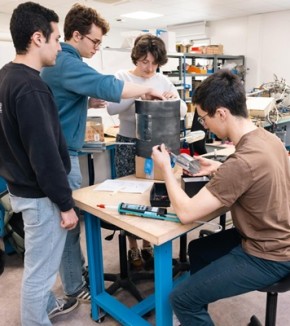
Twelve Collaborative Scientific Projects (PSC) were selected by the teaching and research departments from among the 113 PSCs in the X2024 cohort. A jury composed of prominent figures from academia, the business world, and the media selected three of them during the final round, which took place on September 14.
Bruno Bellier, a senior defense procurement engineer and alumnus of École Polytechnique (Class of 1992), was appointed director general of École Polytechnique at the Cabinet meeting on August 31, 2026. He will also serve as interim chairman of the board of directors until the publication of the new decree governing the School’s organization.
Co-founded by Nobel Prize in Physics laureate Alain Aspect, professor emeritus at École Polytechnique, and Antoine Browaeys, a professor at École Polytechnique, Pasqal—France’s first quantum computing unicorn—is now listed on the Nasdaq. This listing provides the company with approximately $360 million in cash to accelerate its industrial and technological development.
Four Cycle Ingénieur polytechnicien students participated in the 2026 International Mathematics Competition, held in Bulgaria from July 27 to August 2. They once again distinguished themselves with their excellent results, winning four First Prizes, including a Grand First Prize awarded to Georges Tézé, who ranked 5th overall. A fifth Cycle Ingénieur polytechnicien student, Aymane Bouhsain, also won a silver medal.
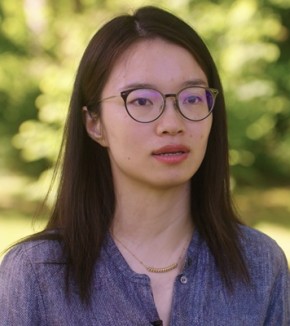
Chinese mathematician Hong Wang (Class of 2010 and recipient of an honorary doctorate from École Polytechnique) has been awarded the 2026 Fields Medal, the highest international honor in mathematics. Honored for her proof of Kakeya's conjecture in three-dimensional space, she became the third woman in history to receive this prestigious award. This award highlights the excellence of her scientific career and reflects her close ties to École Polytechnique, where mathematics plays a central role in the training of engineers and researchers.
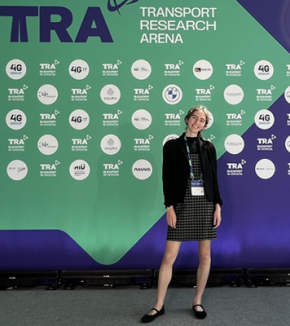
Fiona O’Brien, a student in École Polytechnique’s Master of Science & Technology program “Economics for Smart Cities and Climate Policy”, was invited to present her joint research with Emma Jung, a master's student at TUM, at the TRA (Transport Research Arena). This year, Europe’s largest conference on transport research and innovation took place in Budapest from May 18–21, 2026. Fiona and Emma conducted their research on the impacts of the Paris low-emission zone (ZTL) on mobility and environmental outcomes as part of the “Cities and Transportation” course at l’X.
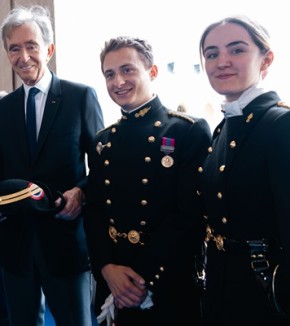
The ceremony formalizing Bernard Arnault’s sponsorship of École Polytechnique’s Institute of Mathematics and Fundamental Sciences project took place on July 2 at the Hôtel des Invalides in Paris, attended by Prime Minister Sébastien Lecornu, Defense Minister Catherine Vautrin, and numerous prominent figures from the political, economic and academic worlds. This institute will host an ambitious program of research and scientific collaborations. Its future building, to be located in the heart of the Palaiseau campus by 2030, will be funded by an exceptional donation of 50 million euros from Bernard Arnault (X69).
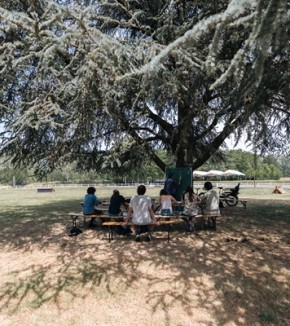
The Polymath Summer School held its second edition at École Polytechnique from June 15 to 26, organized by Guillaume Dubach, a Monge Professor at École Polytechnique and a member of the Laurent Schwartz Center for Mathematics. The program included master classes, group discussions, and math games designed to introduce students to research.
Mathematics, a historic hallmark of École Polytechnique, lies at the heart of many contemporary strategic and technological challenges. To strengthen its international influence in this field and foster interdisciplinary collaboration, École Polytechnique announces the creation of an Institute of Mathematics and Fundamental Sciences, which will host an ambitious program of research and scientific collaboration. Its future building, to be located in the heart of the Palaiseau campus by 2030, will be funded through an exceptional €50 million donation from Bernard Arnault (X69).
 Support l'X