The MSc&T program Data Science and AI for Business X-HEC ranks second globally in the 2027 edition of the QS Masters in Business Analytics rankings. The program retains its top global ranking for employability and has improved its rankings in the categories of Thought Leadership and Value for Money.
When massive stars explode as supernovae at the end of their lives, they emit neutrinos, particles that are very difficult to detect. The Super-Kamiokande detector in Japan has observed the first evidence of the “diffuse supernova neutrino background,” resulting from all of these stellar explosions. The Leprince-Ringuet Laboratory (LLR*) is involved in this research.
Vicky Kalogeiton, a researcher at the École Polytechnique’s Computer Science Laboratory (LIX*), has just received a Starting Grant from the European Research Council (ERC). The goal of her research project FLASH is to make generative image AI more efficient, more accessible, and more sustainable.
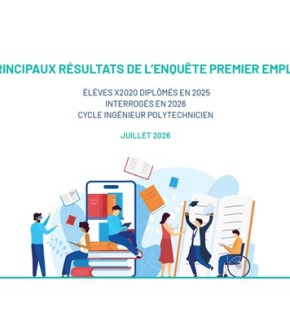
Against the backdrop of a nationwide slowdown in the job placement of recent graduates, the Polytechnique engineers of the Class of X2020, who will graduate in 2025, are reaffirming the strength of their transition into the workforce. One-quarter of graduates enter the civil service, 28% go on to pursue a Ph.D., and nearly half of graduates join the private sector, working at companies of all sizes. Of the graduates who join the company, 97% find their first job in Europe (87% in France), dispelling the notion of a brain drain.
Bruno Bellier, a senior defense procurement engineer and alumnus of École Polytechnique (Class of 1992), was appointed director general of École Polytechnique at the Cabinet meeting on August 31, 2026. He will also serve as interim chairman of the board of directors until the publication of the new decree governing the School’s organization.
Four Cycle Ingénieur polytechnicien students participated in the 2026 International Mathematics Competition, held in Bulgaria from July 27 to August 2. They once again distinguished themselves with their excellent results, winning four First Prizes, including a Grand First Prize awarded to Georges Tézé, who ranked 5th overall. A fifth Cycle Ingénieur polytechnicien student, Aymane Bouhsain, also won a silver medal.
Chinese mathematician Hong Wang (Class of 2010 and recipient of an honorary doctorate from École Polytechnique) has been awarded the 2026 Fields Medal, the highest international honor in mathematics. Honored for her proof of Kakeya's conjecture in three-dimensional space, she became the third woman in history to receive this prestigious award. This award highlights the excellence of her scientific career and reflects her close ties to École Polytechnique, where mathematics plays a central role in the training of engineers and researchers.
By bringing together specialists in optics and biology within the same laboratory, the LOB stands out among research laboratories. This unique setup...
During the 2026 Bastille Day military parade, 360 engineering students from École Polytechnique’s Class of X2025 and their instructors represented École Polytechnique on the Champs-Élysées. Under the theme “Europe’s Strategic Awakening” and in support of Ukraine, this participation highlighted the students’ commitment to serving the nation and the historic bond that unites the School with the Armed Forces.
École Polytechnique ranks 13th globally and retains its top spot in France in the 2026 Digital Leaders in Higher Education ranking, published by Times Higher Education in partnership with Emerging. École Polytechnique also improves its standing in several subject-specific rankings, notably in computer science, where it ranks 8th globally.
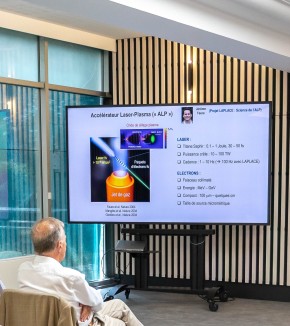
At the Applied Optics Laboratory (LOA*), the CALYCO Chair aims to develop an industrial laser-plasma acceleration system for non-destructive imaging, with potential applications in the energy, aerospace, and automotive sectors. The project is funded by Institut Pierre Lamoure through the École Polytechnique Foundation.
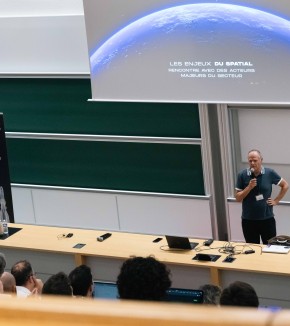
Through an event bringing together scientists and distinguished guests from the French aerospace sector, the École Polytechnique’s “Space: Science and Space Challenges” Chair reaffirms its key role in educating young engineers in this field, combining research, teaching, and industrial partnerships.
 Support l'X