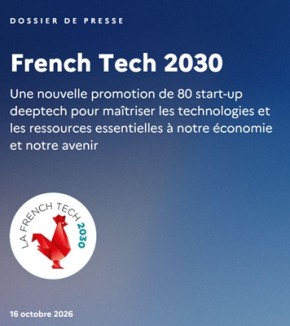
Unveiled by the French Ministry of the Economy and Finance, the 2026 cohort of the French Tech 2030 program recognizes companies that are developing strategic technologies to strengthen France’s technological and industrial autonomy. Of the 80 selected startups, 11 come from the École Polytechnique ecosystem and operate in fields such as quantum computing, artificial intelligence, robotics, cybersecurity, healthcare, and space communications.
École Polytechnique’s Bachelor of Science program combines highly selective admissions with a strong international outlook. The results of the 2026 First Employment Survey of the Bachelor Class of 2023 show that these characteristics are reflected in graduates’ paths after completing the program. Nearly 30 months after graduation, 45% of respondents are employed and 46% are pursuing further studies, either in doctoral programs or in other degree programs.
The LinkedIn Top Startups 2026 France ranking, published in mid-October, highlights twenty startups that have placed artificial intelligence at the heart of their business. Mistral AI, Harmattan AI, Dust, and H Company, which are included in the list, were co-founded or are led by alumni of École Polytechnique. École Polytechnique and CentraleSupélec are currently the two main sources of founders for this list.
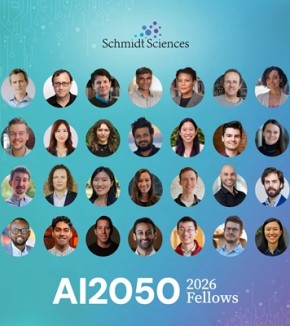
Francis Bach (X1994), a research director at Inria, and Romain Lopez (X2013), a professor at New York University, are among the researchers in the Class of 2026 of the Schmidt Sciences AI2050 program. The first has been named a Senior Fellow, while the second is joining the program as an Early Career Fellow. Both will focus their work on research issues related to the development of safe and beneficial artificial intelligence.
Fields Medalist Hugo Duminil-Copin visited École Polytechnique to share his perspective on learning and practicing mathematics, drawing on his book De l’autre côté du tableau noir – Les mathématiques à visage humain (On the Other Side of the Blackboard – Mathematics with a Human Face). The event also provided an opportunity to highlight the central role mathematics has played throughout École Polytechnique’s history and in shaping its scientific identity.
This award recognizes a career dedicated to the study of quantum phenomena and the development of new experimental approaches in physics. Jacqueline Bloch, a CNRS research director at the Center for Nanoscience and Nanotechnology (C2N)—a joint CNRS-Université Paris-Saclay unit—is also a member of the French Academy of Sciences.
Among the over 3,220 students enrolled at École Polytechnique for the academic year 2026-2027, more than 40 % are international. Admitted to the various degree programs at l’X due to their academic and scientific excellence, they come from around the world to pursue their studies at l’X this year. A diversity of nationalities and backgrounds that enriches the experience for everyone on campus.
The MSc&T program Data Science and AI for Business X-HEC ranks second globally in the 2027 edition of the QS Masters in Business Analytics rankings. The program retains its top global ranking for employability and has improved its rankings in the categories of Thought Leadership and Value for Money.
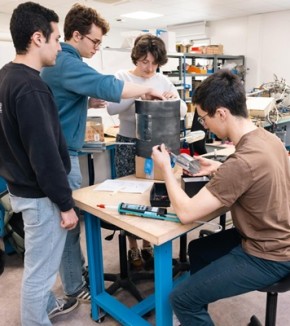
Twelve Collaborative Scientific Projects (PSC) were selected by the teaching and research departments from among the 113 PSCs in the X2024 cohort. A jury composed of prominent figures from academia, the business world, and the media selected three of them during the final round, which took place on September 14.
The French startup Mistral AI has announced a new €3 billion funding round led by Samsung Electronics, bringing its valuation to over €21 billion. Founded in 2023 by three researchers and entrepreneurs, including Arthur Mensch and Guillaume Lample (X2011), Mistral intends to continue developing cutting-edge, open, and sovereign artificial intelligence for the benefit of European companies and institutions.
The American processor designer, Nvidia, has officially announced the acquisition of Hugging Face—co-founded in 2016 by three French entrepreneurs, including two École Polytechnique alumni, Julien Chaumond and Thomas Wolf, both from the Class of 2003—for $12.9 billion. In less than ten years, Hugging Face has established itself as one of the world’s leading platforms for sharing and using open artificial intelligence models.
Against the backdrop of a nationwide slowdown in the job placement of recent graduates, the Polytechnique engineers of the Class of X2020, who will graduate in 2025, are reaffirming the strength of their transition into the workforce. One-quarter of graduates enter the civil service, 28% go on to pursue a Ph.D., and nearly half of graduates join the private sector, working at companies of all sizes. Of the graduates who join the company, 97% find their first job in Europe (87% in France), dispelling the notion of a brain drain.
 Support l'X