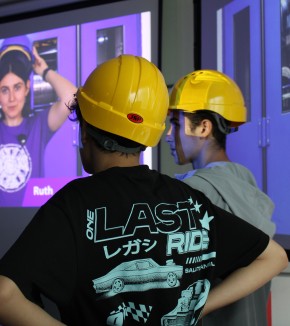
For the European Researchers’ Night on Friday, September 25, high school students from the “Cordées de la réussite” program in Saint-Denis and Argenteuil were invited to tour the laboratories at École Polytechnique. The program included an escape game dedicated to the Higgs boson at the Leprince-Ringuet Laboratory, a sneak peek at the XSeaO2 floating platform, and discussions with researchers from the Molecular Chemistry Laboratory, providing a unique immersion in cutting-edge research.
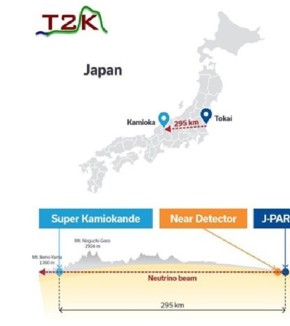
When massive stars explode as supernovae at the end of their lives, they emit neutrinos, particles that are very difficult to detect. The Super-Kamiokande detector in Japan has observed the first evidence of the “diffuse supernova neutrino background,” resulting from all of these stellar explosions. The Leprince-Ringuet Laboratory (LLR*) is involved in this research.
Twelve Collaborative Scientific Projects (PSC) were selected by the teaching and research departments from among the 113 PSCs in the X2024 cohort. A jury composed of prominent figures from academia, the business world, and the media selected three of them during the final round, which took place on September 14.
Elisabeth Maria Niel, Simone Kotthaus, Chloé Techens, and Clément Bonet have received funding from the École Polytechnique Foundation. These Launching Packages will enable them to set up their research teams within École Polytechnique’s laboratories.
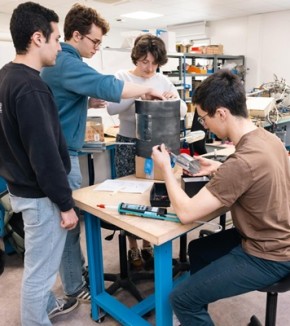
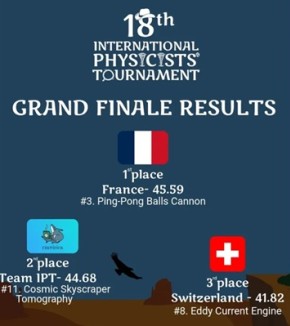
École Polytechnique’s team won the 18th International Physics Tournament (IPT), for which it had qualified by winning the 13th French Physics Tournament. The IPT was held in the United States for the first time in 2026, hosted by Oklahoma State University from May 26 to 30.
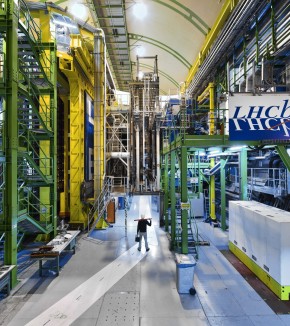
Scientists from the LHCb experiment at CERN, including a team from the Leprince-Ringuet Laboratory (LLR*), gathered for a workshop at École Polytechnique to discuss how to improve the LHCb particle physics experiment over the next decade.
École Polytechnique’s team won the 13th French Physics Tournament. As a result, they have qualified for the International Tournament, which will be hosted in May by Oklahoma State University in the United States.
Neutrinos, elementary particles that are particularly difficult to detect, could hold the key to understanding the distribution of matter and antimatter in the universe. Two major neutrino experiments, T2K and NOvA, have just published a joint analysis of their results in the journal Nature. Margherita Buizza Avanzini, a researcher at the Leprince Ringuet Laboratory (LLR*) and member of the T2K collaboration, explains.
From 27 to 31 October, the Equal Opportunities Unit organised a 'CPGE Boost' course for 30 scholarship students in their first year of scientific preparatory classes, hailing from all corners of France. This edition took place on the École Polytechnique campus for the first time, enabling these young people to envisage themselves in excellence-driven scientific training programmes and to benefit from the ecosystem of a leading engineering school.
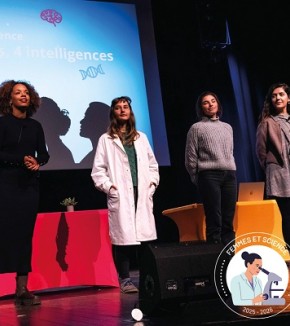
For Science Day 2025, École Polytechnique paid tribute to women. Four female scientists from l’X recounted their career journeys and shared their passion with secondary school students. Take a look back at this inspiring event!
École Polytechnique is launching the construction of a new building to bring together two of its 23 laboratories, support its growth objectives and research ambitions, and implement its commitments to sustainable development.
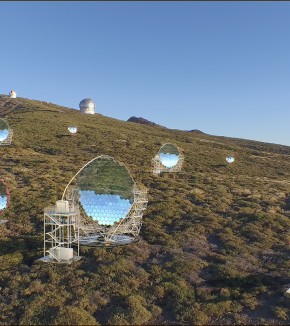
Currently under construction at two sites in the Northern and Southern Hemispheres, the Cherenkov Telescope Array Observatory (CTA) will be the world's largest array of telescopes capable of detecting high-energy gamma rays. The Laboratoire Leprince-Ringuet (LLR*) is heavily involved in this project.
 Support l'X