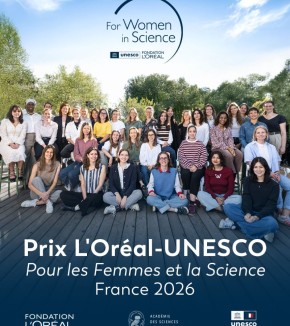
The Ecole Polytechnique is proud to have three female researchers among the 35 winners of the 2026 edition: Kate Sorg, PhD student at the Laboratory...
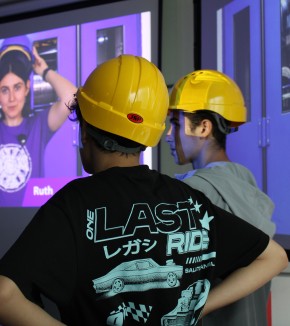
For the European Researchers’ Night on Friday, September 25, high school students from the “Cordées de la réussite” program in Saint-Denis and Argenteuil were invited to tour the laboratories at École Polytechnique. The program included an escape game dedicated to the Higgs boson at the Leprince-Ringuet Laboratory, a sneak peek at the XSeaO2 floating platform, and discussions with researchers from the Molecular Chemistry Laboratory, providing a unique immersion in cutting-edge research.
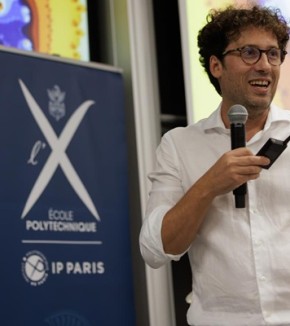
Fields Medalist Hugo Duminil-Copin visited École Polytechnique to share his perspective on learning and practicing mathematics, drawing on his book De l’autre côté du tableau noir – Les mathématiques à visage humain (On the Other Side of the Blackboard – Mathematics with a Human Face). The event also provided an opportunity to highlight the central role mathematics has played throughout École Polytechnique’s history and in shaping its scientific identity.
Gwendal Hénaff, from the Plasma Physics Laboratory (LPP*), and Sooyong Chae, from the Laboratory of Physics of Interface and Thin Film (LPICM*), were recognized at the i-PhD 2026 competition for their doctoral research. They will receive support for developing their entrepreneurial projects. This demonstrates how research that begins as basic science can become the driving force behind practical applications.
Étienne Minvielle, Professor and CNRS Research Director at the École Polytechnique’s Center for Management Research (i3-CRG, jointly administered with...
This award recognizes a career dedicated to the study of quantum phenomena and the development of new experimental approaches in physics. Jacqueline Bloch, a CNRS research director at the Center for Nanoscience and Nanotechnology (C2N)—a joint CNRS-Université Paris-Saclay unit—is also a member of the French Academy of Sciences.
Among the over 3,220 students enrolled at École Polytechnique for the academic year 2026-2027, more than 40 % are international. Admitted to the various degree programs at l’X due to their academic and scientific excellence, they come from around the world to pursue their studies at l’X this year. A diversity of nationalities and backgrounds that enriches the experience for everyone on campus.
The MSc&T program Data Science and AI for Business X-HEC ranks second globally in the 2027 edition of the QS Masters in Business Analytics rankings. The program retains its top global ranking for employability and has improved its rankings in the categories of Thought Leadership and Value for Money.
When massive stars explode as supernovae at the end of their lives, they emit neutrinos, particles that are very difficult to detect. The Super-Kamiokande detector in Japan has observed the first evidence of the “diffuse supernova neutrino background,” resulting from all of these stellar explosions. The Leprince-Ringuet Laboratory (LLR*) is involved in this research.
The American processor designer, Nvidia, has officially announced the acquisition of Hugging Face—co-founded in 2016 by three French entrepreneurs, including two École Polytechnique alumni, Julien Chaumond and Thomas Wolf, both from the Class of 2003—for $12.9 billion. In less than ten years, Hugging Face has established itself as one of the world’s leading platforms for sharing and using open artificial intelligence models.
Vicky Kalogeiton, a researcher at the École Polytechnique’s Computer Science Laboratory (LIX*), has just received a Starting Grant from the European Research Council (ERC). The goal of her research project FLASH is to make generative image AI more efficient, more accessible, and more sustainable.
Against the backdrop of a nationwide slowdown in the job placement of recent graduates, the Polytechnique engineers of the Class of X2020, who will graduate in 2025, are reaffirming the strength of their transition into the workforce. One-quarter of graduates enter the civil service, 28% go on to pursue a Ph.D., and nearly half of graduates join the private sector, working at companies of all sizes. Of the graduates who join the company, 97% find their first job in Europe (87% in France), dispelling the notion of a brain drain.
 Support l'X