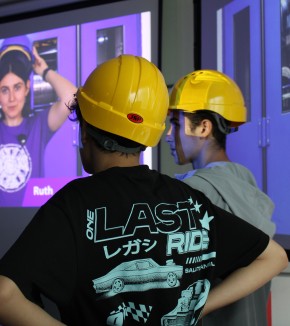
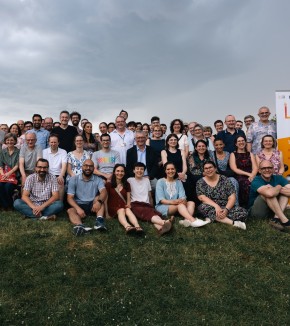
For the European Researchers’ Night on Friday, September 25, high school students from the “Cordées de la réussite” program in Saint-Denis and Argenteuil were invited to tour the laboratories at École Polytechnique. The program included an escape game dedicated to the Higgs boson at the Leprince-Ringuet Laboratory, a sneak peek at the XSeaO2 floating platform, and discussions with researchers from the Molecular Chemistry Laboratory, providing a unique immersion in cutting-edge research.
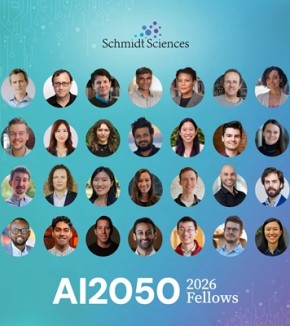
Francis Bach (X1994), a research director at Inria, and Romain Lopez (X2013), a professor at New York University, are among the researchers in the Class of 2026 of the Schmidt Sciences AI2050 program. The first has been named a Senior Fellow, while the second is joining the program as an Early Career Fellow. Both will focus their work on research issues related to the development of safe and beneficial artificial intelligence.
Gwendal Hénaff, from the Plasma Physics Laboratory (LPP*), and Sooyong Chae, from the Laboratory of Physics of Interface and Thin Film (LPICM*), were recognized at the i-PhD 2026 competition for their doctoral research. They will receive support for developing their entrepreneurial projects. This demonstrates how research that begins as basic science can become the driving force behind practical applications.
Étienne Minvielle, Professor and CNRS Research Director at the École Polytechnique’s Center for Management Research (i3-CRG, jointly administered with...
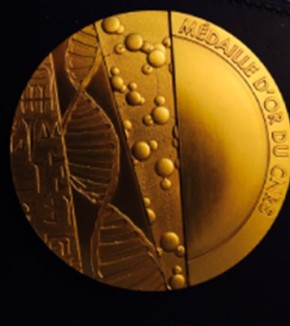
This award recognizes a career dedicated to the study of quantum phenomena and the development of new experimental approaches in physics. Jacqueline Bloch, a CNRS research director at the Center for Nanoscience and Nanotechnology (C2N)—a joint CNRS-Université Paris-Saclay unit—is also a member of the French Academy of Sciences.
When massive stars explode as supernovae at the end of their lives, they emit neutrinos, particles that are very difficult to detect. The Super-Kamiokande detector in Japan has observed the first evidence of the “diffuse supernova neutrino background,” resulting from all of these stellar explosions. The Leprince-Ringuet Laboratory (LLR*) is involved in this research.
Marc-Olivier Renou holds a junior professorship at the Inria Center of the Institut Polytechnique de Paris, within the PhIQus team, and is affiliated with the Center for Theoretical Physics (CPHT) and the Computer Science Laboratory of École Polytechnique (LIX). Through the QINF project, he is exploring a new frontier in quantum information: fermionic bits. This project is funded by a Starting Grant from the European Research Council (ERC).
Vicky Kalogeiton, a researcher at the École Polytechnique’s Computer Science Laboratory (LIX*), has just received a Starting Grant from the European Research Council (ERC). The goal of her research project FLASH is to make generative image AI more efficient, more accessible, and more sustainable.
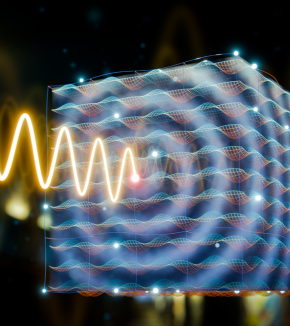
Yannis Laplace’s team at the Irradiated Solids Laboratory (LSI*) has just achieved a major breakthrough by demonstrating the operation of a “temporal photonic crystal.” This finding has been published in the journal *Nature*. This is a collaboration with the Collège de France, the Helmholtz-Zentrum Dresden-Rossendorf, Thales’ Albert Fert Laboratory, and the Laboratory of Physics of Interfaces and Thin Films (LPICM*).
Chinese mathematician Hong Wang (Class of 2010 and recipient of an honorary doctorate from École Polytechnique) has been awarded the 2026 Fields Medal, the highest international honor in mathematics. Honored for her proof of Kakeya's conjecture in three-dimensional space, she became the third woman in history to receive this prestigious award. This award highlights the excellence of her scientific career and reflects her close ties to École Polytechnique, where mathematics plays a central role in the training of engineers and researchers.
Mathematician Hong Wang, X2010 and an Honorary Doctor of École Polytechnique, has just been awarded the Fields Medal in 2026 for her work on the Kakeya conjecture. Here is an overview of a problem whose origins date back more than a century.
By bringing together specialists in optics and biology within the same laboratory, the LOB stands out among research laboratories. This unique setup...
 Support l'X