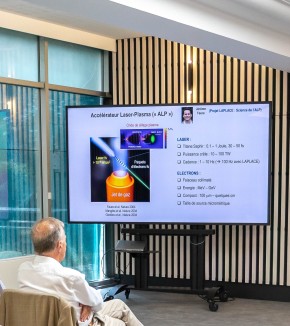
At the Applied Optics Laboratory (LOA*), the CALYCO Chair aims to develop an industrial laser-plasma acceleration system for non-destructive imaging, with potential applications in the energy, aerospace, and automotive sectors. The project is funded by Institut Pierre Lamoure through the École Polytechnique Foundation.
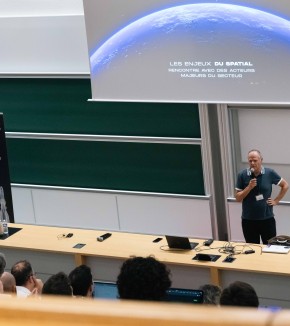
Through an event bringing together scientists and distinguished guests from the French aerospace sector, the École Polytechnique’s “Space: Science and Space Challenges” Chair reaffirms its key role in educating young engineers in this field, combining research, teaching, and industrial partnerships.
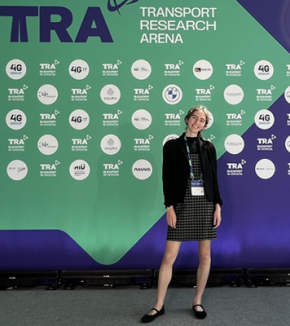
Fiona O’Brien, a student in École Polytechnique’s Master of Science & Technology program “Economics for Smart Cities and Climate Policy”, was invited to present her joint research with Emma Jung, a master's student at TUM, at the TRA (Transport Research Arena). This year, Europe’s largest conference on transport research and innovation took place in Budapest from May 18–21, 2026. Fiona and Emma conducted their research on the impacts of the Paris low-emission zone (ZTL) on mobility and environmental outcomes as part of the “Cities and Transportation” course at l’X.
Professor Éric Vivier, a professor at École Polytechnique and an internationally recognized expert in immunology, is the recipient of the 2026 William B. Coley Prize, one of the world’s highest honors in the field of tumor immunology. This award recognizes his pioneering work on natural killer (NK) cells and their decisive contribution to the development of new approaches to cancer immunotherapy.
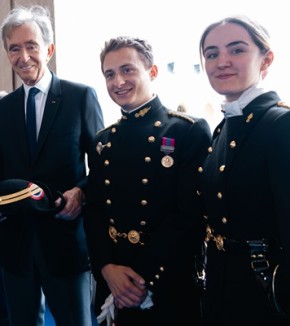
The ceremony formalizing Bernard Arnault’s sponsorship of École Polytechnique’s Institute of Mathematics and Fundamental Sciences project took place on July 2 at the Hôtel des Invalides in Paris, attended by Prime Minister Sébastien Lecornu, Defense Minister Catherine Vautrin, and numerous prominent figures from the political, economic and academic worlds. This institute will host an ambitious program of research and scientific collaborations. Its future building, to be located in the heart of the Palaiseau campus by 2030, will be funded by an exceptional donation of 50 million euros from Bernard Arnault (X69).
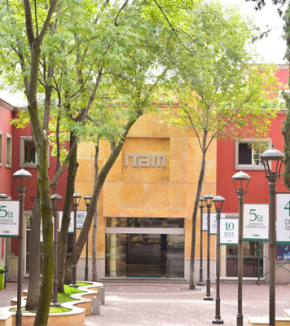
Committed to reinforcing their international collaboration, École Polytechnique and Instituto Tecnológico Autónomo de México (ITAM) signed a new partnership agreement for a double degree program in June 2026. This new partnership fully contributes to École Polytechnique’s international strategy to increase its academic partnerships and presence in Latin America.
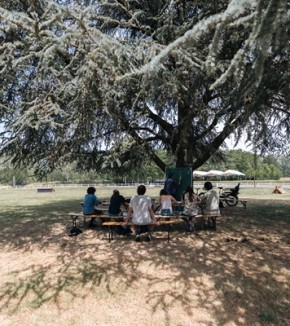
The Polymath Summer School held its second edition at École Polytechnique from June 15 to 26, organized by Guillaume Dubach, a Monge Professor at École Polytechnique and a member of the Laurent Schwartz Center for Mathematics. The program included master classes, group discussions, and math games designed to introduce students to research.
Mathematics, a historic hallmark of École Polytechnique, lies at the heart of many contemporary strategic and technological challenges. To strengthen its international influence in this field and foster interdisciplinary collaboration, École Polytechnique announces the creation of an Institute of Mathematics and Fundamental Sciences, which will host an ambitious program of research and scientific collaboration. Its future building, to be located in the heart of the Palaiseau campus by 2030, will be funded through an exceptional €50 million donation from Bernard Arnault (X69).
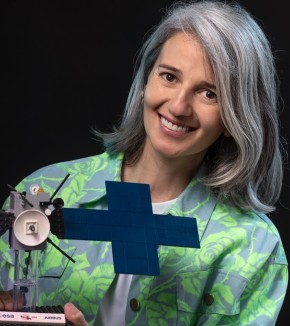
A CNRS research fellow at the Plasma Physics Laboratory (LPP*), Lina Hadid specializes in space plasmas and, in particular, the interaction of the solar wind within the solar system. Interview with a passionate researcher involved in numerous space exploration missions who has just received the Young Researcher Award from the Société Française d’Astronomie et d’Astrophysique.
Nine startups incubated at X-Up, École Polytechnique’s incubator, were present at the VivaTech 2026 trade show, which celebrated its tenth anniversary this year. Polytech students interning at the Orange Group also participated in a roundtable discussion with Christel Heydemann (X94), CEO of the telecommunications and digital services provider, on the topic of digital sovereignty.
Sergio Rajsbaum, researcher at the Universidad Nacional Autónoma de México (UNAM) and CNRS, has spent seven months at École Polytechnique as a Gaspard Monge Visiting Professor. During his visit, he and Professor Éric Goubault further developed a new research line focused on the connections between epistemic logic and distributed computing. This was also the theme of an international workshop organized by the researchers on June 15 – 17, 2026.
École Polytechnique announces the launch of a new degree program for professionals committed to unlock the potential of artificial intelligence. The first class of this new Executive Specialized Master’s in AI is expected to begin in March 2027.
 Support l'X